• home
  • about
  • help
  • contact

Logo

468 x 60 Ads
Navigation
  • ideas
  • articles
  • news
  • music
  • video
    • artists
    • creative
    • devotional
    • humor
    • music
    • news
    • songwriting
    • tech
    • tips
  • top 10
  • church trips
  • polls
  • weekly update

Finding the Right Keyboard Part 2

By Don Chapman | on May 15, 2012 | 21 Comments
ideas
Fantom

I recently visited a church that illustrated the importance of the right keyboard sounds. The band was good, the singers were good but the keyboard player was blaring a cheesy, bland synth pad that ruined the whole thing. A lousy, cheap keyboard patch will make your band sound like it’s straight out of 1986. Hear an example of what I’m talking about:


LISTEN: 


Here’s what I look for in a good keyboard:

1. Touch. Migrating over to a synthesizer isn’t always easy for a trained pianist. However, a firm piano action, full 88 key keyboard will help ease the pain.

2. Sounds. I use about 1% of the presets on a keyboard – the meat and potato patches like piano, strings, wurly and synth pads, leads and textures. The rest are odd, gimmicky sounds you’d hear in Gaga, not Gungor.

3. Ease of use. Steer clear from the keyboards that have 67 knobs, sliders and buttons. Or worse, four buttons with zillions of sub editing menus. These things might sound great but they’re a disaster for a church setting: if you force Aunt Bessie to play one of these things for church she’ll have a nervous breakdown. Look for a simple interface. Nowadays both Yamaha and Roland have keyboards with preset buttons marked for piano, strings, guitars, etc. and are much easier to navigate.

A word of caution: please don’t let the music store salesperson talk you into anything! Hear the keyboard for yourself and let your ears be the judge.

Before I became the music director at a church a few years ago the tech team had decided to purchase a cool, popular keyboard. When the pastor went to the store to pick it up, the salesperson learned that the purchase was for a ministry, and chirped “Oh, all the churches are buying Alesis keyboards.” The pastor, bless his heart, was tricked – he brought back a hideous Alesis which I unfortunately inherited. I refused to use the tinny sounds, opting instead to use the keyboard simply as a midi controller to drive a Roland module. Even that didn’t work – I had heard Alesis keyboards were notoriously buggy and found it to be true. The keyboard would inexplicably send pitch shifting midi data to the module and I’d suddenly find myself a half step flat in the middle of a song. Finally the behemoth broke down a few months later and I got to pick out the keyboard I wanted.

Although I’ve liked Yamaha keyboards in the past, I detest the Motifs – they have the worst, mind-numbing user interface I’ve ever used and it’s nearly impossible to intuitively find, program or save anything. I can live with the Motif piano and strings but I don’t care for most of the patches – they’re thin and bland to my ear.

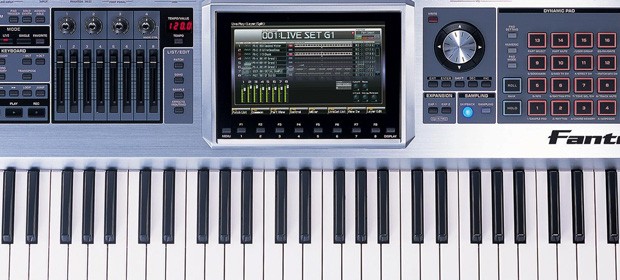
My current favorite synth is the Roland Fantom. I knew I was on target when I was hanging out with Northpoint Church’s music director Reid Greven a few weeks ago – he also loves Fantoms and gets them for all the Northpoint campuses.

The Fantom G series comes in 3 flavors: the G8 with 88 weighted keys, the G7 with 76 regular keys and the G6 with 61 regular keys. They all have the same sounds and can be upgraded with various expansion boards.

No keyboards these days are easy to operate, but I found I could quickly navigate around to many different banks of instruments within 5 minutes. The big color touch screen is nice and you can even use a mouse with it. I really like all the basic sounds – pianos, electric pianos, strings, gurgling textured pads and synth leads are all solid.

And the Fantom has one really big feature Reid pointed out to me: the keyboard has an audio input. Reid plays virtual instruments from his laptop’s audio interface through the Fantom so the sound guys only have to worry about a single stereo keyboard output. We’ll talk about virtual instruments next week.

The Fantom is the only keyboard I’d ever need – visit your local music store and hear it for yourself.

Pics of Northpoint’s keyboard setup:

Northpoint Church Keyboards
By WorshipIdeas  |  View on Facebook
Share this story:
  • tweet

Recent Posts

  • Orchestral Instruments and Modern Worship

    May 13, 2013 - 10 Comments
  • How Loud Should Your Church Worship Service Be?

    May 13, 2013 - 4 Comments
  • Terminal Cancer Revives Carman’s Career

    May 13, 2013 - 0 Comment

Author Description

21 Responses to “Finding the Right Keyboard Part 2”

  1. May 16, 2012

    Richard Huggins Reply

    I always add this to keyboard selection: that pre-choosing a sound will not interrupt the sound then being played. For example, while holding a chord of strings down one could pre-select the piano, and upon the *next* note to be played the new sound would begin.This allows for some smooth transitions, such as a piano starting a line even as the strings from the previous chord are fading out.

    • May 16, 2012

      Don Chapman Reply

      Yes!! This is an excellent comment and I completely agree! I’ll try and drop by the music store this afternoon to see if the Fantom does this.

      • May 16, 2012

        Aaron Lybrand Reply

        It doesn’t out of the box. If there’s a way to configure it that way, I’d love to know the answer.

        • May 16, 2012

          Don Chapman Reply

          I just went to Guitar Center. Of course there’s nobody around to help so I tried it myself. It SEEMS to be able to switch patches. I held down a string pad, scrolled around and selected a piano. The strings continued to sustain and when I played more notes the piano patch sounded. There was a slight hiccup when I changed the patch so I can’t say for sure unless I were to lay out the sounds I wanted in a favorites bank.

          • May 16, 2012

            David Dechow

            Sorry to keep suggesting alternatives, but with a Motif you program what they call “performances” that have four voices of your choice (say, a synth pad, strings, grand piano, electric keyboard – or even user-sampled voices). Then blend the voices as desired by bringing up the mix faders for each voice as you need it. Very nice layered sound with no “jumping” back and forth to different patches (at least for the scope of that programmed performance).

  2. May 16, 2012

    Margaret Gasperson Reply

    Thanks for the great input. Went to a music store and played the Motif. I had seen it on a number of stages, heard it’s the “bomb”, and honestly, I didn’t like it at all. Didn’t like the sounds, no touch screen, and didn’t like the feel of the keys. I’m looking for a store around me that carries the Fantom.

  3. May 16, 2012

    David Dechow Reply

    Hi Don;
    I appreciate that everyone has personal tastes, and contrary to your experiences I find the Motif to be an excellent keyboard. I personally own three Motifs that I use for worship having just added a new XF8. Certainly the popularity of this keyboard among professional players and recording artists alike suggests that the keyboard has significant merit.

    I’ve tried the Fantom and could see and hear differences, but didn’t have the depth of emotion about quality of sound that you have. As for ease of use, any sequencing/sampling workstation has it’s operator interface quirks. The Yamaha line of keyboards, digital recorders and professional digital mixers all follow a similar format so once you understand the operation it is, in my opinion, as easy (or hard!) as any high-end digital musical device.

    Overall though, I think it is not responsible in general to recommend this type of keyboard for all users. Not all churches trying to offer contemporary or blended services are Northridge or Northpoint or Willow Creek. Most have small congregations with part-time unpaid musicians and a keyboard player who in many cases will never make sense or good use of a Fantom or Motif or Triton. They need a more reasonable option and I wish you would have explored that angle a little.

    I was disappointed with this blog in that you made your opinion sound very much like a sales pitch for Roland, and you didn’t offer more realistic alternatives to the real audience of your article: the piano player in an “average” church setting. That said, I do enjoy your sites, comments and music, and wish you the best.

    God Bless,
    David

    • May 16, 2012

      Don Chapman Reply

      I think it’s very responsible of me to recommend the Fantom. This isn’t a product placement for Roland – I simply like the keyboard. And any decent keyboard (acoustic or electric) will cost thousands of dollars no matter which brand you purchase.

  4. May 16, 2012

    Glenn Reply

    Well said done Don! As one mentioned, if a keyboard doesn’t have a smooth transition between patches, I usually won’t buy it for major live performance situations. (See my 2nd response today for your 1st article about my Roland RD experience). Personally, I prefer to have at least two keys on stage, with different touch & size if I’m doing different sounds and accompaniments.

    I usually lead from 2-3 keyboards MIDI’d together, each keyboard has it’s strength & weaknesses of patches, touch and user interface and purpose for me.

    Of course, I’m an old dog that has still has an AKAI AX60 and ESQ1&M stuck in a couple closets because they were my 1st keys and it’s hard to duplicate those old analog sounds; then I have my trusty DX7 I bought on eBay for $25 a few years ago just because I always wanted one and couldn’t afford the $2200 twenty-five plus years ago! :-)

  5. May 16, 2012

    Joe Reply

    That’s great advice. Here’s my issue… the bundle you just linked to is my entire yearly budget. While I personally would say it’s probably worth it, how do you justify something like that on a small budget? That’s probably why that keyboardists was using a crappy pad.

    I’ve been told you can use Propellerhead’s Reason to get good sounds for keys and still use a cheaper keyboard (one that you probably already have). Have you ever had any experience with that?

    Do you have any suggestions for keyboards under $1000 that have good sounds?

    • May 16, 2012

      Don Chapman Reply

      I’ll be talking about virtual synths like Reason next week, but the problem with all that is it’s very complex. I don’t think you’ll get a piano action keyboard in the $1000 range. There are a ton of keyboards out there – you just need to visit a big music store and find one that fits your taste and budget. There’s no easy answer :)

      • May 16, 2012

        Paul Newlin Reply

        Everyone is talking about buying new! I would prefer to work out what I want and then look for it online – even eBay – and so what if it has a small mark on it – I’ve just saved myself (in my case) £500 or more. In fact, I bought my Roland for £1000 including stand and amplifier – and I see that they are still going for more than that.

        Working this way often means that there is no warranty – so there is a risk – but with care and patience you can get what you want for far less than retail. Six years later – and my Roland RD-700SX is still doing the business and is the keyboard of choice for most of our players (some still insist on the digital piano).

  6. May 16, 2012

    Paul Newlin Reply

    My first keyboard was a Korg N1 which lasted me a number of years – incredibly simple to use – but I really felt the pianos just didn’t cut it when leading worship – and after much heartfelt deliberation – trying just about every keyboard that was around at the time – opted for the Roland RD-700SX stage piano.

    This has been brilliant – incredibly simple and has some nice pads that can work with the pianos really well. But time has moved on – stage pianos are – when all is said and done – pianos that think they can do a bit of “synth”. Most people in the church prefer my stage piano to the rather more expensive digital piano!

    Now I would like to move towards a performance keyboard that is the other way round – a synth that thinks it is a piano. It would give more options for backing the other music groups. So it must be extremely simple to use – for Aunt Bessy (!) and default to a really good piano sound – have lots of polyphony so I can layer and split to my hearts content and save these to very quick to select performances.

    On top of everything – the budget is still not up to the limit I would like so it has to be a compromise – and to be honest – the best that I have seen so far – appear to be the Yamaha S90XS and the Kurzweil PC3K8. Portable enough for everyone to lift of the stands yet with the sophistication in sound canvas for even my requirements.

    Both the Fantom and Motif keyboards are way over the top if you have a number of different people playing the same keyboard.

    I guess the reall problem for us – 1 digital piano + 1 keyboard is all we are ever going to have so compromise and multi-use options always have to be considered.

    • May 16, 2012

      Don Chapman Reply

      Every church has an “Aunt Bessy!”

  7. May 16, 2012

    Aaron Lybrand Reply

    Getting to know and understanding the great features of workstation keyboards is something that volunteers generally do not take the time to learn. There’s a whole vocabulary that has to be learned as part of the learning process. I’ve used both the X and G series of the Fantom and I really like both of them. However, my volunteer keyboard players only learn the advanced functions of the keyboard that I have time to teach them during rehearsal (and by advanced I mean anything beyond saving a few favorite patches and switching between them). And since we rotate through several players, this process can take many weeks for each person to learn one new “trick”. Most people are not going to sit down with a 300+ page manual and start working through it. If anyone knows of a good website with tutorials on the Fantom or other workstations, I’d love to check it out.

    • May 16, 2012

      Don Chapman Reply

      I wouldn’t expect a volunteer to know how to program a synth, I can barely program them myself. I’d select the basic patches used most often and create a “favorites” bank and just let them use those.

  8. May 17, 2012

    Greg Reply

    Don,

    Thanks for trying to address a deep subject in a minimal number of paragraphs. There’s so much involved in this decision.
    My background is classical piano training into my teen years and then began playing contemporary Christian music as a young adult. I started playing in bands, buying keyboards (including the venerable Rhodes) and synths and learned to read chord charts and play instrument-appropriate keyboard parts by ear.
    I currently play a Roland Fantom S88 (with Orchestral Expansion) and Yamaha Motif XS6 at church. I also own a Yamaha Motif ES7 and Kurzweil PC3X. Here’s my take on these synths;
    Roland Fantom- acoustic and electric pianos are fine, pads are pretty good, Orchestral Expansion is far better than the internal string sounds (and the Motif series) but not nearly as good as the Kurzweil (see below). I don’t like much else on the Fantom. It’s fairly easy to set up ‘Favorites’ (sounds you’ll use regularly). In general the Roland sounds more processed to me.
    Yamaha Motif- Good acoustic and electric pianos (better than the Fantom to my ears), great organs, very good pads (lot’s of texture and movement). It is easier to set up ‘Favorites’ on the Motif than the Roland. I have around 25 ‘Favorites’ stored for quick access to what is happening in the service. In general, the Motif has a less processed sound than the Roland.
    Kurzweil- Very good acoustic and electric pianos, very good Hammond/Leslie emulation, strings and orchestral sounds are second to none (they sound like a real, live section) with many, many variations. Pads are very good, deep and moving. Pretty easy to set up ‘Favorites’ as well.
    The bottom line is that most all workstations made by Korg, Yamaha, Roland, Kurzweil within the past 5 years will be more than adequate (and sound pretty awesome) in the hands of a decent player that understands how to use the instrument (a challenge in itself).
    Just my 2 cents.
    Blessings,
    Greg

  9. May 18, 2012

    Mara Reply

    I wanted to put in 2 cents on an alternative for churches looking to spend less money on a keyboard but still end up with decent sound. My recommendation would be the Yamaha MOX8. It has graded hammer standard keys which are helpful for the true pianist. Two of the biggest pluses for me were that while it uses the MotifXS synth engine, it only weighs about 32lbs (which is great for small venues which have a multi-purpose stage) and the cost is about $1000 less. As with any professional end keyboard, there will be a learning curve, but I was able to master the basics fairly quickly. (There are tutorial videos on the web as well.) This was my purchase after 9 months of internet research followed by going to stores to listen and feel the keys myself. My one caution would be to warn you that the MOX6 does NOT have the graded hammer keys! (Oh, and if you are talking with a salesman, the name is said MO X 8.)

  10. May 26, 2012

    Chris Reply

    Great article. I’m glad to see you recommend Roland. I personally have a Roland RD-700. One thing I love about it is the seamless flow from patch to patch. Our church has two Fantoms (older models) that are wonderful, but when switching between sounds, the previous patch cuts out. (You have to release the keys and pedals before the new sound “catches”.) This can be frustrating and distracting…especially when trying to “fade” from, say, a string to a pad sound as we slow down. As a result, I bring my personal keyboard when scheduled to play b/c the RD-700 has seamless movement when selecting patches and won’t cut off the previous patch when a new one is selected. As our church is now looking for new keyboards, do the newer Fantoms still cut out when switching patches?

    • May 27, 2012

      Don Chapman Reply

      Unfortunately from what I’m hearing they don’t! That’s also a big deal to me, but I also love the Fantom’s sounds.

  11. June 5, 2012

    Kim Wendt Reply

    I love the Yamaha sounds, but have played Rolands too. I find that the Motifs are way overboard and confusing for me. I agree with Don, the Motif, doesn’t cut it as a live performance synth (GREAT as a studio workstation though). BUT the Yamaha S90 XS or the S70 XS performance workstations DO! They have the motif sounds/engine, but no sequencer. They are barely portable…. because they have a fully weighted, velocity, hammer and graded touch keyboard… feels just like the concert steinway grand. The S70/S90 XS’s have a totally different interface – not at all like the motif, more similar to the MO’s. The deck was built from the ground up with LIVE performance in mind. I can instantly set up totally new performances on the fly, in the midst of the song I’m playing… adding in strings, organs, percussion, brass, etc. to whatever I’m playing… and it does it seamlessly. Sliders fade in/out each part so there’s no ‘train wreck’ during a song. During a live performance, it’s easy to switch back and forth, different sounds, programs, etc. … but later on, in the home studio when I’m working out songs… there’s a deeper level of submenus that are easily accessed to tweak every single bit of sound as much as you’d like. Very detailed, and yet still easy.

    I am not a programmer or synth-head … lots of you are. But I was concerned about learning how to use it. Took me about 2 weeks to figure it all out. (I’d only ever played real piano’s before). I have the S70 SX and it’s in the car 3 to 4 times a week, gigging out. It’s heavy, but it’s worth it.

    Other features I like: 1. transpose buttons, octive shift right there on deck, like the Rolands. 2. 1/4 or XLR input for Vox or another instrument on the back, with dedicated volumn, effects just for that – plus a true Vocoder if you’re into that. 3. Instant layer, splits, drum and arp assigns… quick ability to change the tempo of motion arps or drum lines. Can actually retard and it sounds good, seamless LIVE as you’re playing. 4. Midi channel part bank on right, to instantly turn on/off midi parts as needed. 5. Quick Catagory search feature. 6. Favorites can be saved in Voices, Performances, Multis and Masters PLUS there are lots of USER banks for storing created voices/performances, etc. LOTS of room. 7. Sampler/ will record or play back files (midi, aiff, wav). 8. USB connections – I hook up a passport external USB harddrive…lol. 9. Direct DAW connections/controller. And the best: 10. That LIVE performance deck interface built totally from the ground up, for the needs of a live gigging musican.

    Cons: weight and size. The S70 will not fit in a regular 76 key case. Gotta use an 88case. The 88 key will fit in an 88 key case. No on-deck sequencer. If that’s your thing, get the Motif. You’d understand it whereas I don’t. But note that the S70/S90 XS’s come with Steinburg’s Cubase Ai4 … so you can sequence via DAW/computer no problem. I’m not there yet, but working on it.

    The MO ‘s are a good compromise if you don’t mind squishy keyboard touch/feel. I’ve been thinking of getting the 88 key version, to use as my ‘carry’ keyboard. The interface is similar, without the nice key deck. Solely because of the 60+ lbs of the S70 XS. I’m not getting any younger… lol.

Leave a Reply Cancel Reply

Your email address will not be published. Required fields are marked *

*
*


  • Facebook

    59,051 Fans

  • Twitter

    6,396 Followers

  • YouTube

    303,406 Views

  • Popular
  • Comments
  • Recent
  • Praise Band Paradox

    May 12, 2008 - 48 Comments
  • Should Kids Be Allowed In Worship?

    September 13, 2010 - 46 Comments
  • Is Contemporary Worship Dead?

    August 28, 2012 - 43 Comments
  • Why American Idol Is the Worship Leader’s Best Friend

    March 12, 2012 - 37 Comments
  • Keyboard Player Needed

    January 11, 2011 - 34 Comments
  • Are You A Sloppy Wet Kiss Church?

    May 15, 2011 - 30 Comments
  • Why Your Church Isn’t Bigger

    I've had about 30 followers for the last 10 years but I think besides...
    May 17, 2013 - Tony
  • Why You Should Use Hymns

    Spirit led praise is the key. As an arranger I like to sometimes...
    May 16, 2013 - Harry
  • Elevation Church Confidentiality Agreement

    Might want to ck the source on "others defend it" unless you are...
    May 15, 2013 - Braxton
  • How Loud Should Your Church Worship Service Be?

    The 2nd option is most definitely the way to go. Often times when...
    May 15, 2013 - Conner Byrd
  • Elevation Church Confidentiality Agreement

    What's the point? And how is this scriptural? They have bigger issues...
    May 14, 2013 - Chris
  • Finding the Right Keyboard Part 1

    I played an Alesis QS 8 for years then upgraded to a Kurzweil. ...
    May 14, 2013 - David T..
  • Orchestral Instruments and Modern Worship

    May 13, 2013 - 10 Comments
  • How Loud Should Your Church Worship Service Be?

    May 13, 2013 - 4 Comments
  • Terminal Cancer Revives Carman’s Career

    May 13, 2013 - 0 Comment
  • Church Cuss Words

    May 13, 2013 - 0 Comment
  • What Happens When Your Songs Are Too High

    May 13, 2013 - 1 Comment
  • Elevation Church Confidentiality Agreement

    May 13, 2013 - 2 Comments

WorshipIdeas.com in Worship Leader Mag