What if the very thing we’re most proud of—our commitment to Scripture—has become the reason we’re okay with being mediocre at everything else?
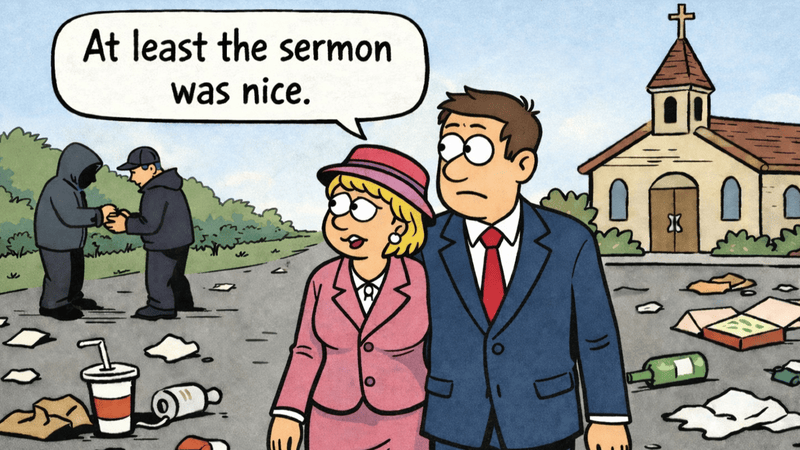
I know a church with phenomenal preaching. The pastor is gifted, faithful, deeply rooted in the Word. Every Sunday, the sermon is rich with gospel truth. But the parking lot is chaos. The signage is confusing. First-time guests wander the hallways like they’ve been dropped into a maze. The sound system cuts out at least once per service. And when someone mentions it, the response is always the same: “Well, we’re not here for show. We’re here for the Word.”
Here’s the uncomfortable truth. That’s not theology. That’s an excuse. And we’ve gotten really good at dressing up our laziness in holy language.
The Holy Language We Use to Justify Unholy Sloppiness
There’s a term for what happens when we use high-sounding biblical language to justify poor quality work: theologizing mediocrity. It’s when “We’re Word-centered, not seeker-sensitive” becomes code for “We don’t have to try very hard at anything else.” It’s when a commitment to doctrinal faithfulness somehow gives us permission to be sloppy in every other area of church life.
We say “God knows my heart” when the sound mix is muddy again. We say “People will overlook it if the preaching is strong” when our service planning is haphazard. We say “We’re trusting God’s sovereignty” instead of actually fixing what’s broken. We’ve created a false choice between being biblical and being excellent, as if caring about quality somehow compromises our devotion to Scripture.
But here’s what we’re really doing. We’re shrinking the reach of God’s Word down to a 40-minute sermon slot. We’re acting like Scripture only matters when the pastor is behind the pulpit, not when we’re training volunteers or planning transitions or checking the batteries in the wireless mics. We’ve convinced ourselves that theology is something that happens in the big moments, not in the details. And that’s just bad theology.
The Resurrection Changes Everything, Including Your Parking Lot
A high view of God should never lead to a low view of excellence. If anything, it should demand the opposite. Because the God we serve doesn’t do anything halfway. He spoke worlds into existence with precision. He orchestrated redemption with meticulous care. He raised Jesus from the dead with power that will one day remake all of creation. And we bear His image.
Paul Tripp calls it “awe amnesia.” It’s that slow fade where we lose sight of God’s glory and start treating His work like it’s ordinary. When we forget how magnificent our God is, we start thinking it’s okay to be mediocre in His name. We lose the plot. We start believing that “good enough” is actually good enough when we’re serving the King of the universe.
David Prince asks a diagnostic question that should haunt every worship leader: “How does the fact that Jesus Christ is risen from the dead impact the way we do this?” Not just how we preach, but how we do this. How we organize volunteers. How we choose songs. How we train greeters. How we plan rehearsals. How we communicate with our teams.
Because Ephesians 1:10 tells us that God’s plan is to sum up all things in Christ. Not just doctrine. Not just preaching. All things. The logistics. The aesthetics. The relationships. The mundane Tuesday afternoon email about who’s running slides this week. Christ is claiming all of it. Every function of ministry is territory we get to declare “Mine!” on His behalf.
So when we plan a worship service, we’re not just filling time between the opening prayer and the benediction. We’re stewarding a space where people will encounter the living God, and that matters. Your song selection matters. Your transitions matter. Your sound mix matters. Your rehearsal culture matters. These aren’t “less than” activities that we tolerate so we can get to the “real” ministry. This is ministry. And it deserves our best.
The First Sermon Your Guests Hear Isn’t From the Pulpit
Here’s what I’ve learned. People start forming opinions about our church (and our God) long before the pastor opens his Bible. They form opinions in the parking lot when no one helps them figure out where to go. They form opinions at the welcome desk when the greeter seems frazzled and unprepared. They form opinions when the website says service starts at 10:00 but nothing actually happens until 10:12. They form opinions when the worship leader forgets the words to the second verse or when the kids’ ministry looks like it was organized by someone who’s never actually met a child.
Truthfully, when our high theology doesn’t match our low execution, we create a credibility gap. We’re like an obese fitness trainer telling people how to get healthy. We preach that Christ is supreme over all things while our sloppy practices scream “Actually, this doesn’t really matter.”
That’s not a small problem. That’s a gospel problem. Because the secondary stuff—the parking, the signage, the volunteer training, the sound check, the order of service—isn’t secondary at all. It’s the first sermon your guests hear. And right now, for a lot of churches, that sermon is saying that we care about ideas, but we don’t care about you. We care about truth, but we don’t care about experience. We care about being right, but we don’t care about being good.
Worship leaders, your rehearsal culture preaches. Your communication with volunteers preaches. Your preparation rhythm preaches. The question is, what are they preaching?
We’re Not Aiming for Broadway—We’re Aiming for Faithfulness
Now here’s the nuance, because we need it. Excellence is not the same thing as professionalism. There’s a danger on the other side of this conversation, and we need to name it. When slick production values replace humble service, we’ve lost something essential. When the mentality of the professional replaces the mentality of the slave of Christ, we’re chasing the wrong thing. True excellence isn’t about competing with the megachurch down the road or creating a theatrical experience that wows people into submission.
True excellence is simpler than that. It’s maximizing what God has given you. It’s doing the best with your resources, your people, and your context. It’s thoughtful stewardship, not neurotic perfectionism. It’s asking “What would faithfulness look like here?” not “What would impress people?”
I’ve seen small churches do simple things with such care and attention that you could feel the love of Christ in the room. And I’ve seen large churches do elaborate things with such polish and professionalism that the whole experience felt cold and manufactured. Excellence isn’t about scale or budget. It’s about heart. It’s about offering your best to the One who gave His best for you.
So no, we’re not trying to be Broadway. But we’re also not using “We’re just a small church” as an excuse to be careless. Because the God we serve doesn’t grade on a curve.
How to Stop Theologizing Your Way Out of Excellence
So how do we break the cycle? How do we stop using good theology as a cover for bad ministry? Start by auditing your ministry through one simple lens: Does this reflect the glory of the God we worship? Not “Is this good enough?” Not, “Will people complain?” But by asking, “Does this honor the One we’re here to serve?”
Go through your worship planning process, your rehearsal standards, your volunteer communication, your tech training, your kids’ ministry setup, and your guest services. Ask David Prince’s question at every step: How does Jesus’ resurrection change how we approach this?
And then be willing to change. Reject “We’ve always done it this way” as a theological argument, because it’s not one. Create a culture where feedback is welcomed, not feared. For worship teams especially, this is huge. Receiving critique isn’t a personal attack. It’s kingdom work. It’s how we sharpen each other.
Start small if you need to. Pick one area where mediocrity has become normalized and address it. Maybe it’s your sound mix. Maybe it’s how you communicate the service plan to your team. Maybe it’s the way you transition between songs. You don’t have to fix everything today, but you do have to start somewhere.
Because every detail is an opportunity to say “Mine!” on behalf of Christ. Every moment is a chance to reflect the excellence of the God who made galaxies and names stars and numbers hairs and raises the dead.
The Good Gift of God-Honoring Excellence
Here’s what I want you to hear. Ministry isn’t just about what we say from the platform. It’s about how we display the beauty of Christ in everything we do. And a high view of God—a truly high view—demands a high standard of work. Not to earn His love. We already have that. Not to prove we’re worthy. We’re not, and that’s the whole point of grace. But because we’ve been entrusted with the best news in the history of the world, and that news deserves better than our leftovers.
When we refuse to let bad theology excuse lazy practice, something shifts. When we let the resurrection reshape even our smallest tasks, we discover that faithfulness in the details is its own kind of worship. We discover that excellence isn’t about performance or perfectionism. It’s about love. It’s about offering the best of what we have to the One who offered the best of what He had.
And when a church operates like that—when the preaching is strong and the parking lot is welcoming, when the theology is deep and the sound mix is clean, when the Word is central and the details are cared for—people notice. Not because we’re trying to impress them. But because they’re catching a glimpse of a God who does all things well.
That kind of faithfulness, friends, is a very good gift.