Sometimes we forget that Sunday morning worship isn’t an out-of-body experience.
I know, I know. We talk about “encountering the Spirit” and “transcending the ordinary,” and those things are absolutely true. But somehow we’ve let a weird kind of spiritual Gnosticism creep in. Like the really important stuff happens in some ethereal realm while our physical selves are just along for the ride.
But this is not so.
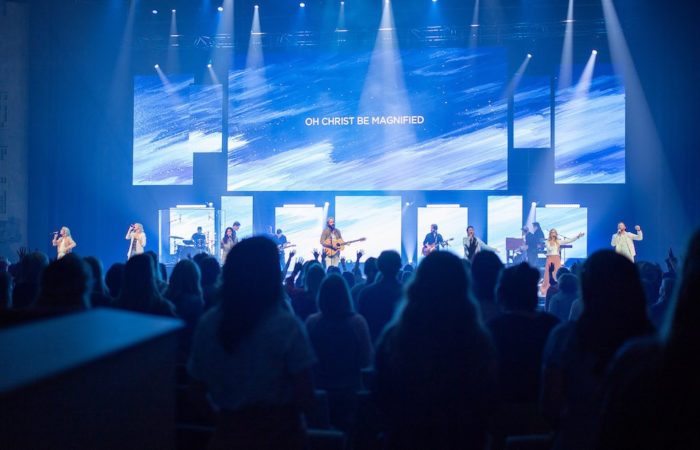
When your congregation opens their mouths to sing, they’re doing something achingly, gloriously physical. Their lungs expand. Their vocal cords vibrate. Sound waves bounce off your sanctuary walls. The drummer counts off. The keys are either right or they’re not. This is material. This is embodied. And this matters more than we think.
Because the truth is that the church isn’t gathering to sing, like we’re some kind of sacred karaoke night. We’re singing as the church—a supernatural entity knit together not by our zip codes or our musical taste, but by the blood of Jesus and the power of the Spirit. When that retired schoolteacher in the third row joins her trembling soprano with the college kid’s uncertain bass, they’re not just making noise. They’re manifesting the temple where God actually dwells.
That’s ecclesiology. That’s the doctrine of the church happening in real time, with real breath, in a real building.
Why God Gave Us Mouths, Aside from Eating and Talking
The theology of congregational singing works on two axes, and we need both.
First, the vertical. We sing to God. And this isn’t some novel idea we invented. God Himself sings. Zephaniah 3:17 tells us the Lord “will rejoice over you with singing.” The Creator of the universe, who spoke galaxies into existence with a word, also lifts His voice in song over His people. Let that settle in your bones for a minute. And Jesus? He sang with His disciples right before the worst night of His life (Matthew 26:30). If the Son of God made room for congregational singing hours before Gethsemane, maybe we should stop treating it like the warm-up act.
Our singing is a sacrifice of praise, an offering that draws attention to God’s goodness, not our vocal prowess. Which is why your sound engineer doesn’t need to be a Grammy winner and your alto section doesn’t need to nail every interval. The idea here isn’t perfection. The idea is aiming attention upward.
Second, the horizontal. We sing to each other. Paul tells the Colossians to let the word of Christ dwell richly in them as they teach and admonish “one another” in psalms and hymns and spiritual songs (Colossians 3:16). Did you catch that? “One another.” Singing isn’t just Godward. It is also sideways. It’s didactic. It cements doctrine in hearts and minds in ways that sermons alone cannot.
When your congregation addresses one another in song, passive spectators become active participants. They’re building up the Body. They’re preaching to each other without even realizing it. That simple chorus about the cross? It’s doing seminary-level work in the heart of the teenager who can’t afford college and the widow who forgot what hope feels like.
What Science Knows That We’re Just Remembering
Turns out, God built something remarkable into the act of communal singing, and modern research is finally catching up.
Neurochemistry doesn’t lie. When people sing together, their bodies release oxytocin, the bonding hormone. The same chemical that floods a mother’s brain when she nurses her baby floods your congregation’s brains when they sing “How Great Thou Art.” Add in the endorphins, which create feelings of pleasure and reduce social anxiety, and you’ve got a recipe for real connection. Group singing also tanks cortisol levels, giving everyone a biological reset button for their stress-soaked nervous systems.
Researchers have documented what they call the “icebreaker effect”. Group singing is literally the fastest way to bond strangers. Faster than small groups. Faster than potlucks (though I still recommend potlucks). Faster than trust falls and team-building exercises. There’s something about lifting our voices in unison that creates what sociologists call communitas—intense social cohesion that transcends normal social barriers.
And here’s where it gets fascinating. Studies have shown that when a congregation or choir sings together, their heart rates synchronize. Their hearts actually begin to beat in unison. Their bodies physically manifest the spiritual unity the Spirit is creating. You can’t make this stuff up.
So when you feel like Sunday morning singing is just “the thing we do before the sermon,” remember: God designed it to literally change the chemistry and rhythm of His people’s bodies.
How We Lost It (And How We Got It Back)
The early church sang. Simple canticles, psalms, maybe a hymn or two. Everybody participated.
But then something shifted. By the Middle Ages, the church had professionalized the whole thing. Monasteries had trained choirs singing sophisticated polyphony while laypeople stood silent, relegated to the role of audience. The song of the church became the song of the trained church, and regular folks were left out.
Then came the Reformation, and Martin Luther showed up swinging. He restored the priesthood of all believers partly through giving them their voices back. Luther didn’t just write hymns, he weaponized music against despair and turned it into a teaching tool for doctrine. “A Mighty Fortress Is Our God” wasn’t written for concert halls. It was written for butchers and bakers and candlestick makers to sing their theology into their bones.
John Calvin took a different tack with metrical psalmody, insisting that only God’s Word was sufficient for the church’s song. But the point was the same. Congregations should sing, not just listen.
By the 18th century, Watts and Wesley shifted the focus toward personal, emotive faith—hymns that helped people sing their own stories into God’s larger narrative. This “singing faith” essentially defined modern Protestantism, for better and worse.
But here’s what all these reformers understood. When the church stops singing together, something vital dies.
The Tensions We Live With Every Week
Let’s be honest about the struggle between production and presence. We live in an age of Spotify-perfect vocals and stadium-level production values. So there’s pressure to make Sunday morning sound like a concert. But here’s the danger. When the congregation becomes passive observers instead of a participating priesthood, we’ve missed the plot. Celebrity culture and high-production values aren’t evil, but they can subtly shift the focus from “we worship” to “we watch them worship.” And that’s a problem.
Then there is excellence versus accessibility. You want your music to be beautiful. Of course you do. But if your melodies require a two-octave range and your rhythms confuse anyone over fifty, you’ve left people behind. The keys need to be singable. The rhythms need to be clear. Musical beauty that excludes the average person isn’t beauty. It’s elitism dressed up in worship language.
Finally, there is the role of weakness. This is the hardest one. Your congregation’s singing might be halting. Out of tune. Imperfect. And that’s okay. Because the power doesn’t rest in technical perfection. It rests in the Spirit’s presence. God isn’t listening for pitch-perfect harmonies. He’s listening for hearts that long to honor Him, even when the notes come out wobbly.
Some of the most powerful worship moments I’ve witnessed involved terrible singing. Because the people weren’t performing. They were pouring out their hearts.
Why This Matters More Than You Think
The church’s singing does something we often forget. It bears witness to the unseen.
Paul writes in Ephesians 3:10 that the church exists “so that through the church the manifold wisdom of God might now be made known to the rulers and authorities in the heavenly places.” Read that again. When your congregation lifts their voices, they’re making the wisdom of God known to the heavenly realms. Angels and demons and powers we can’t even imagine are watching. And what they see is a ragtag collection of sinners saved by grace, from every background and every story, unified in song.
That’s a witness more powerful than any sermon.
And every Sunday, when you lead your people in song, you’re giving them a foretaste of eternity. Revelation describes a multitude from every nation, tribe, people, and language singing a new song before the throne. Sunday morning is rehearsal for that. It’s practice for the eternal choir we’ll join when all the broken things are finally made whole.
So keep leading. Keep singing. Keep inviting your people to open their mouths and let the Spirit shape their breath into praise. The acoustics might be terrible and the alto section might be struggling, but you’re participating in something ancient and eternal and sacred.
And that, my friend, is a very good gift.