
What if the most missional thing you could do on a Sunday morning is stop trying to be missional?
Stay with me here. Because if you have been leading worship for any length of time, you have felt the tension. The unspoken pressure to make the service accessible. Appealing. Not too churchy. You want the person in the third row who got dragged in by their neighbor to feel welcome, not alienated. That impulse is not wrong. It is, in fact, beautiful. But somewhere along the way, for a lot of churches, that beautiful impulse quietly became the architect of the entire service. And that is where things get derailed.
When the Audience Shifts, Everything Shifts
Here is the core problem. Corporate worship, historically, biblically, and theologically, is the assembly of the called-out gathering to meet with God. The church comes together to encounter the living God, to be shaped by His Word, to respond to His grace. Evangelism is not absent from that. But it is a byproduct of a God-exalting service, not the blueprint for it.
When we design Sunday primarily for the unbeliever in the room, we subtly swap out the vertical axis for a horizontal one. We move from God-to-people and people-to-God, to a church trying to impress a visitor. And everything including the song selection, the sermon arc, and the whole vibe starts to bend in that direction.
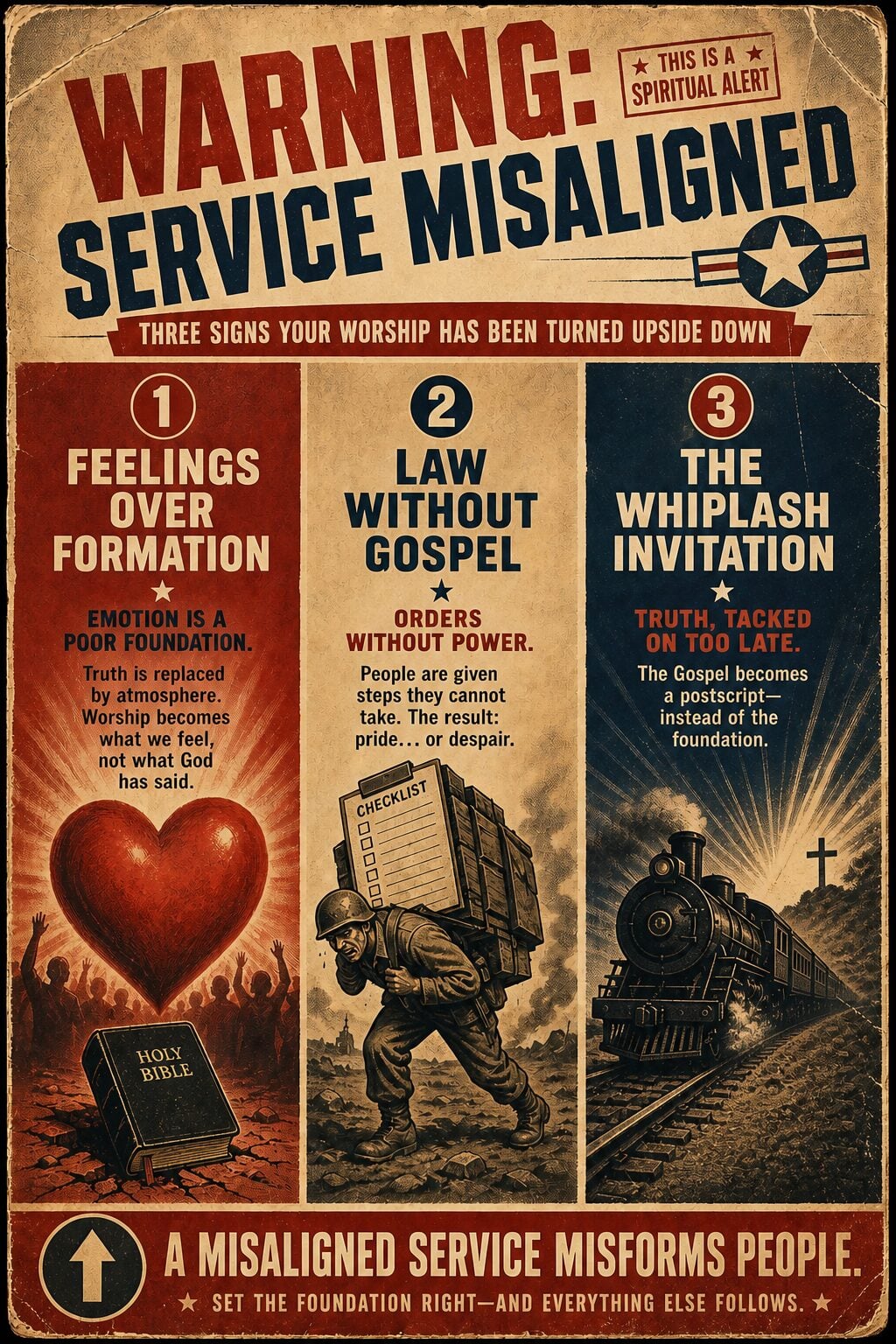
Three Ways a Service Gets Derailed
It does not happen all at once. But here are three symptoms worth watching for.
The first is feelings prioritized over formation. Music that emphasizes emotional connection over theological content is not inherently evil. Emotion in worship is a gift. But when the songs we choose ask people to sing deeply personal declarations of love and devotion to a God they do not yet believe in, we have asked something impossible of them and, honestly, something a little unfair. Worship becomes more about the feeling in the room than the truth being proclaimed. And feelings, left untethered from doctrine, drift.
The second symptom is Law without Gospel. This one stings a little, especially for those of us who sit under practical, applicational preaching. “Five steps to a better marriage.” “Three habits of highly faithful people.” These are not bad topics. But if the sermon is primarily behavioral modification aimed at an audience that includes spiritually dead people, people who, without the Holy Spirit, genuinely cannot do what you are asking of them, then we have handed them homework they cannot complete. And the result is either pride (I am nailing this Christian thing) or despair (I will never be enough). Neither is the Gospel.
The third is what you might call the whiplash invitation. Forty minutes of “you are awesome and God is wild about you” followed by two minutes of “and by the way, you are a sinner in need of a Savior.” That last bit is true. Completely true. But it lands as a postscript rather than the foundation. And the Gospel deserves better than a postscript.
What “Right-Side Up” Worship Actually Looks Like
The biblical pattern is straightforward, even if it is not always simple to execute. It moves from Revelation to Response.
God acts first. Through the reading of Scripture, through the proclamation of the Gospel, through the singing of truth, God reveals His character, His holiness, His grace. He initiates. Always. And then the congregation responds. Confession. Praise. Petition. Recommitment. The whole service is a conversation, and God goes first.
That is the vertical axis. And it has to come before the horizontal. You cannot have genuine community formation, genuine care for the lost, or genuine outward mission without first being a people who have genuinely met with God. The horizontal grows out of the vertical. Not the other way around.
Attractional vs. Gospel-Centered: An Honest Look
There is a reason the seeker-sensitive model took hold. It was trying to solve a real problem: how do we reach people who feel alienated from the church? This is honorable. But the solution, taken to its logical end, produces a service where the primary audience is the seeker, the core message becomes practical self-improvement, music exists to manufacture atmosphere, and the lost are treated as potential customers rather than spiritual image-bearers in desperate need of new life.
A Gospel-centered service operates from a different set of assumptions entirely. God is the audience of One. The core message is Jesus Christ and Him crucified. Music facilitates corporate confession and praise. And the lost are seen for what they truly are, not projects to attract and retain, but people who need the living God to breathe life into them. That is a different posture. And it produces a different service.
The Beautiful, Counterintuitive Truth
Here is the irony that should encourage every worship leader in the room. A service that is unapologetic, anchored in deep doctrine, the holiness of God, and the sufficiency of Christ, is often more compelling to a spiritually hungry outsider than a service that mirrors the world back at them. The world is full of self-help. It is full of sentimentality. What it does not have is the actual Gospel. That is the one thing only the church can offer.
The proper order has always been this: Doxology (glory to God) leads to edification (the growth and formation of the church) which leads to mission (the reaching of the world). You cannot shortcut to mission by skipping doxology. It does not work that way. It has never worked that way.
So, worship leader, here is your directive. Build the service for God first. Preach the Gospel as the main course, not the garnish. Choose songs that are theologically true before they are emotionally manipulative. Trust that a people genuinely formed by encounter with the living God will be, by their very nature, the most compelling witness in the room.
That kind of service, the right-side up kind, is a very good gift.