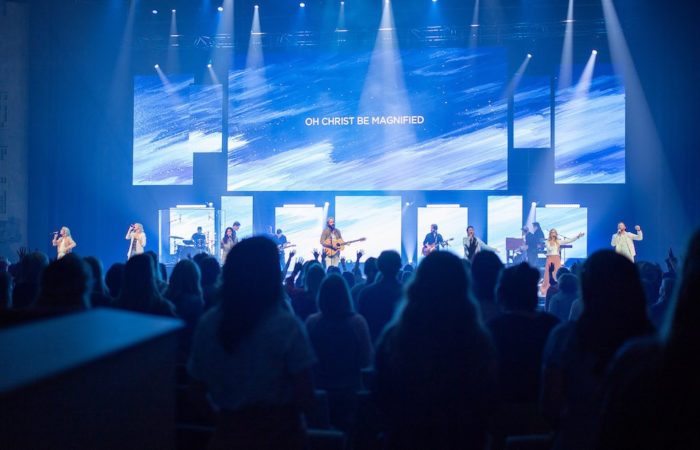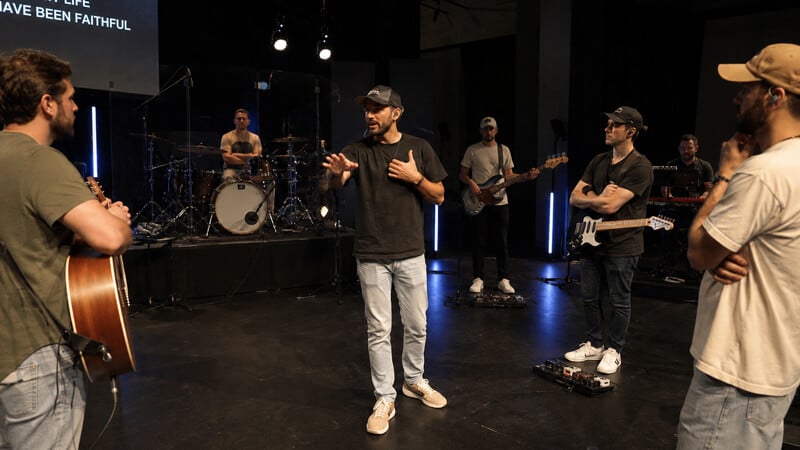
Most worship leaders rehearse their set in the order it appears on Sunday morning. That’s backwards, and it’s why your hardest song never quite comes together and your transitions feel shaky. Here’s a smarter rehearsal plan that fixes both!
I’ve played in or led more worship rehearsals than I can count! Some were tight, focused and over in an hour. Others dragged on for three hours because the worship leader was still picking his song order while the band sat around twiddling their thumbs (I’ve written about this before here at WorshipIdeas!)
After years of good rehearsals and terrible ones I can tell you the one principle that separates the two: practice is personal, rehearsal is relational. Your volunteers should be learning their parts at home during the week. Rehearsal is where the team assembles and puts the whole service together.
If your musicians are hearing the songs for the first time at rehearsal, you’re already behind!
The Schedule
So how long should a good rehearsal be? For a volunteer worship team I’d recommend 75 to 90 minutes. Here’s the schedule I’d use:
Before the clock starts: Setup, tuning and line check. Musicians should arrive early enough to plug in, tune up, set their monitors or in-ears, load charts and solve any obvious gear issues. The official rehearsal clock should not begin with everyone still setting up. Leaders need to get there first so systems are ready when volunteers walk in.
1. Prayer and service overview (10 minutes). Pray together. Briefly explain the service theme, the Scripture or pastoral emphasis, the song order and any unusual cues. This doesn’t need to be a 20 minute devotional. Keep it focused so your team knows what the service is about and how the music supports it.
2. Sound and monitor check (7 minutes). Use the intro, verse and chorus of the first song to confirm house sound and monitor levels. Keep this under seven minutes.
3. Hardest or newest song first (15 minutes). Do not start with song one just because it’s first in the service order! Start with the song most likely to fail. New song, tricky groove, difficult key change, exposed intro. Get it right while everyone is fresh and focused.
If you save the hard stuff for the end of rehearsal (when everyone is mentally checked out and thinking about dinner) you’re setting yourself up for a rough Sunday!
4. Transitions and service flow (15 minutes). This is where most rehearsals fall apart, because most worship leaders skip it entirely. Rehearse the moments between songs: count-offs, pads, who starts the next song, capo changes, prayer-into-song moments, Scripture readings, communion handoffs, video transitions and even planned silence.
If you’ve ever had that awkward dead air between songs on Sunday morning, it’s because you didn’t rehearse your transitions. Transitions should be planned and practiced, not left to chance.
5. Vocals (10 minutes). Work lead entrances, harmony parts, blend, cutoffs, vowel shapes and who sings which verse. Pay special attention to how vocalists re-enter after spoken or prayer moments. Keep the band present if the vocal cue depends on the groove, vamp or transition.
6. Endings, tags, cues and trouble spots (10 minutes). Rehearse endings, repeat choruses, ritards, stops, “watch me” cues and any place where uncertainty could distract the congregation. A shaky ending is the last impression people take home with them.
7. Final run-through, no stopping (20 to 25 minutes). This is the most important part of your entire rehearsal. Run the full worship set as close to service conditions as possible. Include speaking, prayers, Scripture, countdowns, slides and every transition. Do not stop unless something truly breaks.
This is where your team learns the live flow of the service. Skipping the run-through is the single biggest reason transitions and vocal cues get missed on Sunday. Set a hard start time for this run-through and protect it.
8. Final notes, prayer and release on time (3 to 5 minutes). Give only essential fixes. Confirm call time. Remind everyone of the main cues. Pray. And release your volunteers on time. They have families and lives, and honoring their time builds a culture where people actually want to show up next week!
The 60 Minute Version
If 90 minutes feels like too much for your team (or your songs are familiar and there’s no major new material) you can trim this to 60 minutes. Here’s how:
1. Prayer and overview: 6 minutes
2. Sound check: 6 minutes
3. Hardest song first: 13 minutes
4. Transitions and service flow: 13 minutes
5. Vocals, endings and cues: 9 minutes
6. Final run-through: 11 minutes
7. Final notes and prayer: 2 minutes
For a 60 minute rehearsal I would not try to play every song multiple times. Drill the risky sections and protect the run-through. The run-through is non-negotiable no matter how short your rehearsal window is.
Principles That Hold It All Together
Send the plan early. Your volunteers need the service order, song keys, charts, recordings, song maps and transition notes well before rehearsal. Put it all on Planning Center (or whatever you’re using) early in the week so your team can prepare at home. If they show up having never heard the songs, that’s a leadership problem, not a musician problem.
Rehearse in order of risk, not in order of service. The newest, hardest or least-known song comes first. Always. Then drill the extras: transitions, dynamics, altar moments, response songs and off-script arrangements.
Make the run-through sacred. Set a hard start time for the run-through and do not let anything else encroach on it. This is the one thing that consistently gets cut when rehearsals run long, and it’s the one thing that makes the biggest difference on Sunday morning.
Include tech when the service flow depends on it. If slides, lighting, countdowns, videos or tracks affect the worship flow, your tech team needs to be part of the run-through. There’s nothing worse than a perfectly rehearsed band blindsided on Sunday morning by a slide that doesn’t advance or a video cue that fires at the wrong time.
Start on time. This sounds obvious, but I’ve seen plenty of rehearsals lose 15 to 20 minutes right off the top because people straggled in late and setup wasn’t done. If someone needs extra time to set up, they need to arrive before the official rehearsal window. Starting on time sets the tone for everything that follows.
Try This Week
Take a look at your current rehearsal. Are you rehearsing transitions? Is there a protected run-through? Are your volunteers getting charts and recordings early enough to prepare at home? If the answer to any of those is no, pick one and fix it this week. You’ll feel the difference on Sunday.
Bottom Line: Practice happens at home, rehearsal is where you put the service together, and protecting your final run-through will do more for your Sundays than any other single change you can make.