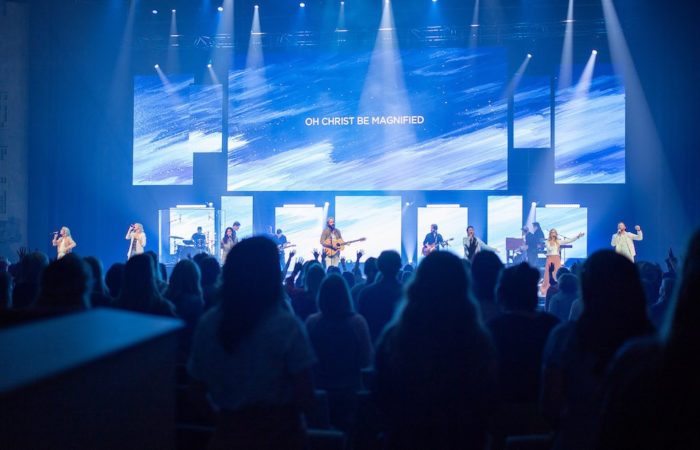
Somewhere in your sanctuary this Sunday sits a woman who just found out the chemo isn’t working. A man whose wife left three weeks ago. A teenager who has already decided this is his last month alive. And your production meeting this week was about whether the haze machine is too much for the second verse.
All of these things can be true at once, but not all of them carry the same importance.
The Fight That Shouldn’t Be Happening
There’s a argument that shows up every so often in church world. Someone writes a piece about coffee bars and stage lighting diluting the gospel, and half of church twitter nods along while the other half gets defensive about their new LED wall. Production bad, spiritual depth good.
In all honesty, lights are not the enemy. Neither is coffee the enemy. A well-run sound board is also not the enemy. The danger was never the tool. The danger lies in when the tool quietly becomes the point.
Why This Actually Matters
Think about a good restaurant. Most don’t go for the ambient lighting or the music playing softly in the background, they go for the meal. But if the lighting is harsh or the chairs are uncomfortable or the music is blaring, it gets in the way of the meal. People notice and they don’t come back. Good atmosphere doesn’t replace the food, it just gets out of the food’s way.
That’s what your production should be doing every week. Getting out of the way of Jesus, not becoming Him.
And this is where it gets serious, because if your gathering exists mainly to entertain people or wow them visually, it has quietly stopped functioning as the Church. It has become something else wearing church clothes. A concert has lights and a good set list too. What makes Sunday different from a concert isn’t the fog machine. It’s the presence of the Holy Spirit and the raw, unavoidable reality of a crucified and risen Christ. If a stranger could not tell the difference between your gathering and a well-produced show, that’s considering.
What Most Churches Try, And Where It Quietly Falls Apart
Most churches land in one of two camps, and both of them miss the actual issue.
Camp one strips everything back, assuming bare and simple automatically means sacred. No lights, no coffee, no anything that could be labeled a production value, because surely that’s more spiritual. Except minimalism doesn’t guarantee depth any more than maximalism guarantees shallowness. You can have a stripped down stage and still never once acknowledge the grieving mother in row twelve.
Camp two goes all in on excellence and energy, chasing a bigger, better, more polished experience every single week, and quietly forgets to ask who is actually sitting in the room. This is the camp that burns out its team planning flawless transitions while nobody plans for the divorced dad who is barely holding it together in the third row.
Both camps are asking the wrong first question. The right first question was never lights or no lights. It is, instead, whether we have considered the suffering in this room.
The One Question That Should Drive Every Planning Meeting
Every single weekend, without exception, your congregation includes people carrying weight you cannot see from the stage. The grieving, the terminally ill, the addicted, the lonely, and the suicidal are not a hypothetical demographic. They are sitting in specific chairs, right now, this week, every week.
If your high energy production has nothing to say to that person, you have built something that can wow a room and still leave the most broken people in it completely alone. That should stop every worship leader and every executive pastor in his tracks, because it means excellence without pastoral awareness isn’t neutral. It’s actually a quiet form of neglect.
Grace matters here, too. Whoever is planning your services is carrying real weight, logistics, budgets, volunteer schedules, a hundred moving parts, and that deserves patience rather than cynicism. This isn’t about villainizing the people building the run of show. It’s about making sure the run of show was built with the hurting in mind from the start.
Try This Sunday
Before you finalize the set list this week, ask a different question than usual. Not does this song sound good. Ask does this song have anything to offer the person getting chemo on Tuesday. Does it hold up under real weight, or does it only work on a good day.
Look at your lyrics the way you’d look at a letter you were sending to someone in the ICU. Catchy and self-focused emotional highs don’t survive that setting. Comfort, truth and real hope do. Write and choose songs that can actually sit with someone in the dark, not just songs that sound great with the lights up.
And whatever you decide about production, whether you keep the haze machine or retire it, whether the stage stays elaborate or goes bare, let it all answer to one priority above every other. Give them Jesus. Not a vibe or an experience, Him.
Because the woman with the bad scan results and the man whose marriage just ended didn’t come for the lighting design. They came, whether they could say it out loud or not, hoping somebody up front actually had something real to offer them.
Make sure you do.
Because that, friend, is a very good gift.