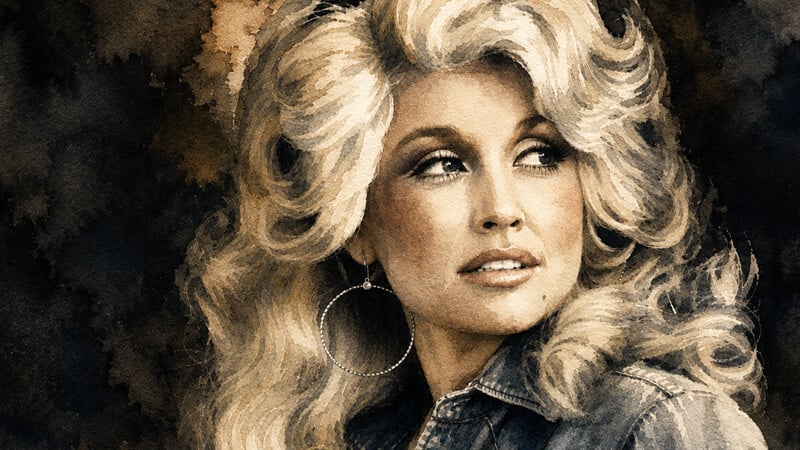
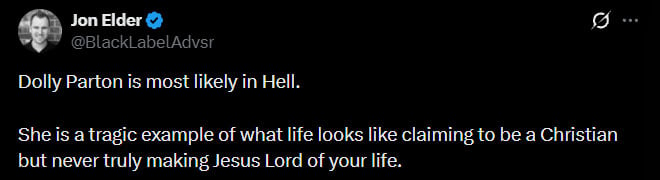
Since the death of Dolly Parton I’ve seen numerous posts on social media from those grouchy, sour reformed-types (and this coming from someone who considers himself both reformed and grouchy!) proclaiming to the dumb, theologically illiterate masses that “Dolly Parton is in hell!”
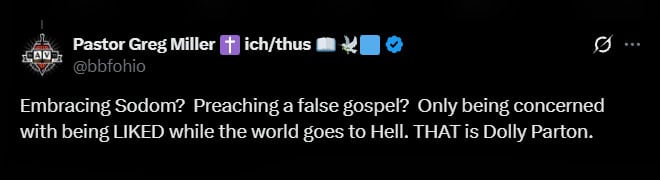
This is really nothing new as Dolly has courted controversy her entire life. Even her own grandfather (a Pentecostal preacher) reportedly thought early in her career that her flashy image meant she was “going to hell in a handbasket.” She said a song she co-wrote with her aunt Dorothy about him (“Daddy Was an Old Time Preacher Man”) helped change his view.
Yes, she was an LGBTQ supporter and cultivated a deliberately provocative public image in her younger days (Playboy cover (no nudity), starred in The Best Little Whorehouse in Texas, the list goes on.) At times in her career she expressed belief in reincarnation and multiple religious traditions. But as many tend to do as age creeps in, she leaned into a more Christian stance in her later years.
Was Dolly Parton “saved?” Here in the South we have two types of Christians: the cultural ones and the real ones. Did she look to Jesus as her Savior and repent of her sin? Of course, only the Lord knows her heart, but we can look at what she’s said in her own words – both in interviews and in her song lyrics.
I’m a songwriter and arranger, so I put priority on the songs Dolly wrote herself. Recording a Gospel song can be a record label decision. Writing your own song about sin, Jesus, the cross and heaven tells us more. Dolly wrote both “The Seeker” and “Welcome Home” entirely on her own (more about that later.)
Dolly Parton’s Faith Quotes: What She Said About Jesus, Sin and Salvation
In Alanna Nash’s 1978 biography Dolly, Parton is quoted saying she believed in God and had been baptized, “but I don’t consider myself a Christian.” She reportedly added, “If anything, I’m just a sinner.”
On face value, that does seem to settle the whole matter.
Except for the context. Dolly explained that she was pouring far more time and effort into her career than into God, and she didn’t want to be a hypocrite by claiming a label she wasn’t living up to. Cultural Christians rarely lose sleep over hypocrisy; they check the “Christian” box on the survey and get on with their day. The person who says “I don’t live well enough to call myself a Christian” hints at somebody wrestling with the concept.
Dolly’s salvation story: “I must have got saved 15 times”
Now for the most important story she ever told about her faith. She told it at least twice, six years apart, and the details do match.
She grew up under her grandfather’s Pentecostal preaching, the hellfire-and-altar-call variety. As a kid she went forward over and over. On the 2025 Khloé in Wonder Land podcast she put it this way: “I must have got saved 15 times but never did.” Back in 2019 on Dolly Parton’s America she said, “I never, never felt like I was saved.”
That’s a telling statement. Even as a child, Dolly sensed a difference between responding to fear and experiencing something genuine. Walking an aisle, crying at an altar and getting dunked in the creek did not automatically convince her she had been saved.
Then, around the age of twelve, she wandered alone into an abandoned church near her home. It had broken windows, a damaged piano and dirty writing on the walls. People apparently used it for drinking and fooling around.
She played the remaining piano keys, sang and prayed without a preacher bearing down on her. Her prayer was simple: “Show me, help me, save me.”
Dolly said a deep peace came over her. She believed she had finally and genuinely found God: “I felt like I found God that day.”
She also put a version of this in writing long before either interview. In her 1994 autobiography, Dolly: My Life and Other Unfinished Business, she described praying in earnest one day and said she “broke through some sort of spirit wall and found God.” The God she found was not the bombastic bully of her childhood sermons. He was someone she could talk to one on one, like a friend.
Does this give us the complete, neatly packaged evangelical testimony some people demand? No. Dolly did not walk through the Romans Road and explain substitutionary atonement.
She did say she was seeking and believed God answered her.
Dolly Parton on Jesus (specifically, by name)
Plenty of celebrities will talk about “God” or “the universe” or “something bigger than myself.” Dolly used broad spiritual language, too. Yet she also talked specifically about Jesus, by name, for decades.
- 2008, NME: “I grew up in a Christian family, so anything about Jesus is good.”
- 2011, Knoxville News Sentinel (as attributed by later sources): “Jesus is right here close to me, and he’s my friend.”
- 2016, CBN: “I grew up knowing that Jesus loves me.” When asked why she brought her faith into secular entertainment: “Why not? That’s who I am. That’s what keeps me going.”
- 2018, AL.com / Southern Living: “I do believe that Jesus loves me.” She went on to say a true Christian’s heart is open, meaning open to people rather than condemning them.
- 2020, The Christophers: “The story of Christ went year-round in our place.” And on the belief that Jesus loved her: “It’s in my songs, my heart, my speech.”
- 2021, after winning a Grammy for “There Was Jesus” with Zach Williams: Her official website reported her response began with “Thank you Jesus.”
Over the years I have taken note of which spiritual leaders talk about “Jesus.” I’ve heard many harp on John Calvin and/or the Westminster Confession 90% of the time and Jesus 10% (I have heard some in this crowd never mention Jesus’ name.) Dolly’s Jesus talk, for me personally, is a big tell of her true spiritual state.
“I won’t make fun of Jesus”
More Jesus talk: Dolly hosted Saturday Night Live on April 15, 1989. In the SNL oral history Live From New York, cast member Jan Hooks recalled Dolly setting exactly two rules for the writers: “I won’t use any cuss words and I won’t make fun of Jesus.” Everything else was fair game.
Thirty-six years later, in 2025, Dolly was asked about collaborating with Sabrina Carpenter and said, unprompted: “I don’t cuss. I don’t make fun of Jesus. I don’t talk bad about God.”
Same rule, same order, 36 years apart.
Spiritual, not Religious
Dolly said “spiritual, not religious” for most of her life. In a 1984 Interview magazine piece she explained she had rejected the picture of God as cruel and vindictive, waiting to throw people into hell. That was a reaction to the fear-based preaching of her childhood, and she said so.
She also said things that won’t fit in an evangelical box, and some of them are worse than the “spiritual, not religious” line. In that same 1984 conversation she described sin and evil as the negative pole of a battery, something you need alongside the positive to be a complete person. She said celebrities are idols and that we’re all gods, so to speak. In 2019 she admitted she wasn’t sure what happens after death and mused about reincarnation. In a 2024 New Humanist interview and again in 2025 she talked about God in terms of nature, science and energy.
The hardest one comes from July 1989. William Stadiem asked her point blank whether she was still active in the Pentecostal church, and Dolly answered that she never goes to church (which honestly doesn’t bother me a bit – global superstars simply can’t attend their local church. Here’s Steve Harvey’s comical account of trying to take Michael Jackson to church.) She said she wasn’t a religious person but was very spiritual, that God is love, and she described a great energy and a great love bigger than all of us – typical “celebrity-speak.” A few questions earlier, asked about Shirley MacLaine’s beliefs, she said she had studied all kinds of religions and faiths and was open to everything.
And here is what I did not find anywhere in an interview: “I accepted Jesus Christ as my personal Lord and Savior.” “I was born again.” “Jesus saved me from my sins.”
So that’s the case against. Now here’s where the conversation completely flips. In that very same 1989 interview, three questions after she said she never goes to church, Stadiem asked her about a song.
“Tell me about the song about Jesus, ‘He’s Alive.’”
Dolly explained: It’s a beautiful song. I found it years ago. My husband and I were drivin’ back to Nashville from California, out in the middle of nowhere, and we couldn’t get a big radio station. We were just punching around, and on this local station in the desert we heard this song. We pulled into the next gas station and called them up to see who it was. It was Don Francisco, and they gave us the information off the back of the album, and when we got back to Nashville we looked the record up. I’ve been wanting to record that song for years. It’s the story of the Crucifixion through Peter’s eyes. Peter was the one who betrayed Jesus. (editor’s note: Dolly apparently misspoke here. Peter denied Jesus; Judas betrayed him.) It’s so emotional. Bein’ very spiritual, I like to say something about god somewhere in my albums.
Another interview contains what I think is the most important evidence. Dolly again described hearing “He’s Alive” while traveling with Carl. She said:
“We both got chill bumps.”
She tracked down Don Francisco’s album when she returned to Nashville and said:
“I always intended to do it because it moved me.”
Here’s the key part. Dolly explained that she had waited because she wanted to record it with someone who shared its Christian meaning. She chose Ricky Skaggs because he was a Christian and “accepted that whole concept.”
Then Dolly said:
“You have to really feel something and be passionate about it and believe in it to do it.”
“I’m not as religious as Ricky but my faith is as strong in its way. The song meant a lot to me.”
Dolly said that to perform this material properly, you have to believe in it. She then explicitly connected the song with her own faith.
Dolly Parton Song Lyrics Analysis: “The Seeker” and “Welcome Home”
Why song lyrics count as evidence
Songwriters write characters all the time, and Dolly wrote plenty of them. Her 1998 song “When Jesus Comes Calling for Me” sounds like a testimony until you learn she described it as being about an old man facing the end of his life.
So the test for treating a lyric as testimony has to be strict: Dolly wrote it alone, it’s in the first person, and it lines up with what she said in interviews.
Two songs do pass that test, and they bookend her spiritual life.
“The Seeker” (1975): a sinner standing outside the door
Dolly wrote “The Seeker” by herself, recorded it in December 1974 and released it in 1975 with Porter Wagoner producing. It’s a prayer. The narrator calls herself a sinner, weak, empty and unable to fix herself, and asks to be led to a fountain where her sins can be washed away.
It sounds like a conversion song, but Dolly herself told us it wasn’t.
In a 1977 Rolling Stone interview with Chet Flippo (reproduced in the anthology Dolly on Dolly), she explained where the song came from. Some friends had gone through a spiritual renewal and their happiness got her thinking about religion. Her words: “I just could not decide whether I wanted to be a Christian or not.” She said she felt the Lord was going to have to strike her dramatically because she wasn’t going to make the decision on her own, and she “wrote that out of a heavy heart.” In the same interview she described herself as “certainly not a Christian.”
So “The Seeker” is the prayer of someone under conviction who hasn’t yet walked through the door. Set it beside the 1978 “I’m just a sinner” quote and you’re looking at the same woman in the same season of life.
Check what the lyric contains and what it doesn’t. Sin and helplessness? Yes. A plea for cleansing? Yes. Jesus and the cross? No. Resurrection? No. Any assurance that forgiveness has been received? No. Dolly herself admitted in her 2020 book Songteller that the song never names God or Jesus, and she said she didn’t notice until somebody pointed it out years later.
(The fountain imagery probably echoes the old hymn “There Is a Fountain Filled with Blood.” Dolly grew up singing those hymns. She never confirmed the connection, though, so that’s just my educated guess.)
If you want a second witness, listen to her 1971 song “Golden Streets of Glory.” She wants to walk those streets and worries she isn’t clean enough to get in. Same longing and same missing assurance.
The problem with Dolly’s memory of “The Seeker”
In 1977 Dolly said she couldn’t decide whether to be a Christian. In 2020 she remembered writing the song because she “wasn’t being as good a Christian as I should have been.” In 2025 she told the Country Music Hall of Fame, “I have always been a seeker in every way.”
Those don’t say the same thing. The likeliest explanation is that Dolly’s later faith reshaped how she remembered 1974. The 1977 quote is closest to the event, so it’s probably more accurate. Either way, the song reads as someone still seeking.
The bridge: Hungry Again (1998)
Something happened between the seeking and the assurance, and it seems to have happened on a mountain in Tennessee. In 1997 Dolly withdrew to her property, prayed, fasted, asked God for direction and wrote dozens of songs. The result was the 1998 album Hungry Again. She recorded “Shine On” in the House of Prayer, the church where her preacher grandfather had served, with members of the congregation singing.
She never announced a conversion date. But a woman who fasts and prays for weeks and then goes back to her grandfather’s church to record is clearly moving toward God, whatever label you put on it.
“Welcome Home” (2003): the full Gospel in Dolly’s own words
Now for the song lyrics that are the most convincing about Dolly’s spiritual state.
Dolly wrote “Welcome Home” for her 2003 album For God and Country. She said the idea came from watching television footage of families greeting soldiers coming home.
The first part of the song is that earthly homecoming. In the third verse the song changes. Dolly thinks about the families who lost a son and never got their homecoming, and from there she moves to Jesus dying for all our sins, to God loving us enough to send His only Son, and to that Son living, dying and then living again. Then she puts herself in it and sings that she hopes to hear God say “welcome home” when it’s her time to go.
Dolly never sings “I am saved.” She sings that she hopes to hear “welcome home.” That is hope rather than a formal profession.
I find her lyric choices to be very interesting. At the end of a song about soldiers coming home from war, she decides to drop in “Jesus died for all our sins” and the resurrection. The fact that Dolly wrote the song herself, used first-person language and placed herself within the Gospel story makes it significant evidence of what she believed by 2003. Go back to the question I asked at the beginning. Did she look to Jesus as her Savior? Cultural Christians don’t write lyrics like that.
The Gospel verse begins at 2:16
The arc from “The Seeker” to “Welcome Home”
Lay her interviews and lyrics out in order and you get a progression any pastor would recognize:
- 1971, “Golden Streets of Glory”: wants heaven, doubts she’s clean enough.
- 1975, “The Seeker”: confesses sin, begs for cleansing, undecided about Christ.
- 1978, Nash biography: “I’m just a sinner.”
- 1998, Hungry Again: prayer, fasting, recording in her grandfather’s church.
- 2003, “Welcome Home”: “Jesus died for all our sins.”
- 2019 and 2025, interviews: “Christian faith person,” “I found God that day.”
- 2025, unreleased song: she told Khloé Kardashian she’d written one called “Jesus Is the Only Friend I Need,” explaining that when nobody else was available she could go to Jesus and find peace.
Uncertainty, then conviction, then renewal, then a plain statement of salvation through Christ, then a woman in her late 70s calling Jesus the only friend she needs. She never gave us that conversion date, but it’s a lot more than “she believed in God.”
Final Years and Dolly’s Christian Music Connection
Her final years might be the best evidence of her faith.
In 2019, Dolly told her manager she wanted to record more inspirational music. Not a farewell to country, just more songs with what she called “a little more light.” She explained it to Fox News that November: “I’ve just felt like God was calling me into that. I’ve always felt like my music was more my ministry than a job.”
Unbelievably, she’d barely finished telling her manager when two explicitly Christian songs landed in her lap, almost back to back.
for KING & COUNTRY: “God Only Knows”
“God Only Knows” was already a huge Christian radio hit from for KING & COUNTRY’s 2018 album Burn the Ships. Joel and Luke Smallbone had always imagined a female voice on it but never found the right one, so they recorded it themselves.
Then Joel watched Dumplin’ on Netflix (the movie is practically a Dolly jukebox) and started thinking about her for the song. He also had a personal connection: he had taught Sunday school to people in Dolly’s management circle. Through those relationships, the song reached her.
The timing stunned Dolly. “I had just told my manager how I was going to go into doing more inspirational music,” she said. She described the invitation as God opening a door: “It was just like God said, ‘Okay, why don’t you sing on this song.’”
When the brothers first heard her vocal, Joel said “we immediately realized that this song was meant for her voice.” The lyric deals with shame, loneliness and hidden suffering, and the idea that God knows a person’s true condition when no one else does. The Smallbones felt Dolly’s life gave those words a credibility a younger singer couldn’t provide. She went further than a guest vocal, too: in the music video she portrayed a woman caught in prostitution, dramatizing the song’s message that God sees the worth of people others judge or overlook.
The results were amazing. The Dolly version put “God Only Knows” on the Billboard Hot 100, for KING & COUNTRY’s first appearance on the all-genre chart, and introduced the band to mainstream country listeners who had never heard Christian radio. On January 26, 2020, the song won the Grammy for Best Contemporary Christian Music Performance/Song.
Zach Williams and “There Was Jesus”
The second song grew out of Zach Williams’ own testimony. Before his Christian music career, Williams spent years chasing a rock career while struggling with drugs and alcohol. Looking back, he recognized moments in those years when he believed Jesus had been present and working even though he didn’t see it at the time. That became the song’s central idea.
The demo had a female vocal on it. When Williams’ wife heard it, she suggested Dolly Parton. Williams thought the idea was laughable, but his team had a connection to her management and sent the song over. Dolly said yes almost immediately: “I loved Zach’s voice, and at that time I wanted to do something more uplifting. I felt like it was a Godsend.”
Once again she tied the song’s arrival to the direction she believed God was leading her.
The two had never met before the session. Williams said Dolly spent several hours on her vocal rather than singing a quick part and leaving, and asked him how he heard the song and what he wanted from her. He said she had “a way of making you feel like you are the only person in the room.” According to Williams, she also didn’t ask for a songwriting share, even though her name would obviously raise the record’s value. She participated because she believed in the song. Before they finished, she told him, “You’re gonna win a Grammy for this song.”
“There Was Jesus” reached No. 1 on Billboard’s Christian Airplay chart and held the spot for several weeks. It won Song of the Year at the 2021 K-LOVE Fan Awards, and on March 14, 2021, it won the Grammy for Best Contemporary Christian Music Performance/Song. Her official website reported that her response began with “Thank you Jesus.”
Two Grammys in two years
This is quite the timeline! In 2019 Dolly decided she wanted to record more spiritual music because she felt God was calling her to it. Two Jesus-centered songs arrived within months. On November 13, 2019, she performed both at the CMA Awards, which she co-hosted with Carrie Underwood and Reba McEntire, with for KING & COUNTRY and Zach Williams joining her on stage. “God Only Knows” won the contemporary Christian Grammy in January 2020. “There Was Jesus” won the same category in March 2021.
Back-to-back wins in the same Christian music category, on songs she didn’t write, by an artist who had described her music as her ministry.
The relationship with Williams continued. She brought him onto her 2022 NBC special Dolly Parton’s Mountain Magic Christmas to perform “There Was Jesus,” and in 2024 she recorded a new version of his song “Lookin’ for You” after, by his account, asking him why he hadn’t invited her to sing on it in the first place!
None of this settles the question of Dolly’s salvation. But it makes one thing difficult to argue: that her later faith was simply generic Nashville God-talk. In her final years she deliberately pointed her career toward songs about Jesus, described that decision as God’s leading, and called the whole enterprise her ministry.
Was Dolly Saved?
Growing up in the church, attending Christian grade school and graduating from a Christian college, I’ve seen this arc many times: kids learn the basics of Christianity, go hog wild in their teen and young adult years, get married, settle down and return to their faith as they raise a family. They may even think they’re saved because they grew up in church, later doubt it, and make a real profession of faith well into adulthood.
I’ve worked in Reformed churches where the average person in the pews is a mini-theologian. I’ve also worked in “seeker sensitive” megachurches where the average attender is genuinely saved, but boy, do they still have some nutty new age baggage. These people are “unchurched” and simply new to all this Bible stuff.
This is more or less what Dolly’s own record shows. Attended church as a little girl. Seeking and undecided in 1975. “I’m just a sinner” in 1978. Fasting and praying on a Tennessee mountain in 1997. “Jesus died for all our sins” in 2003. Jesus as the only friend she needed at 79.
What those grouchy, sour Reformed guys are loath to tell you is that you can have faulty theology and still get into heaven if you have the core faith that Jesus saves you from your sin. The story of the thief on the cross teaches this.
Everyone who calls on the name of the Lord will be saved
Bottom Line: Did Dolly Parton have faulty theology? Absolutely. I certainly wouldn’t want her teaching a Sunday School class! However, I believe she was a spectacularly talented, giving person who grew up in church, strayed through the wackiness and worldliness of the entertainment industry, yet somehow retained a simple love and belief in Jesus. I hope to see her in heaven one day.
Now I think of all the families that have lost a darling one,
And I think how Jesus died for all our sins,
And I think how much God loved us to send his only son,
To live and die, and then to live again.