Quick Facts: Billy Corgan
- Full Name: William Patrick Corgan Jr.
- Born: March 17, 1967, in Elk Grove Village, Illinois
- Best Known For: Co-founder, lead singer, primary songwriter, and guitarist of The Smashing Pumpkins, formed in Chicago in 1988
- Landmark Albums: Siamese Dream (1993) and Mellon Collie and the Infinite Sadness (1995)
- Awards: Frontman of the multiple Grammy Award-winning Smashing Pumpkins
- Other Bands: Zwan (2001–2003), whose album Mary Star of the Sea reworked Henry Francis Lyte’s hymn “Jesus, I My Cross Have Taken”
- Solo Albums: TheFutureEmbrace (2005), Ogilala (2017), and Cotillions (2019)
- Author: Blinking with Fists (2004), a New York Times bestselling book of poetry
- Other Ventures: Owner and president of the National Wrestling Alliance (NWA), owner of Madame ZuZu’s Teahouse in Highland Park, Illinois, and host of the podcast The Magnificent Others
- Faith Background: Raised Catholic; left church at age eight and returned at 28
- Confession of Faith: In a September 2026 podcast conversation with Michael Sweet of Stryper, spoke of believing in Jesus as his Lord and Savior
Every awards season, some artist steps to the microphone and thanks God. Such moments are nice and polite, for every good gift does comes from above. Yet a word of thanks toward God can be spoken by nearly anyone, and on its own, it tells the listener very little about the one speaking it. There is a deeper confession, one the Bible treats with far greater weight: that Jesus is Lord. In 2026, Billy Corgan, frontman of The Smashing Pumpkins, made that very confession, and it was the fruit of a search that had spanned most of his life.
Billy Corgan’s Catholic Roots
Billy Corgan was born in Elk Grove Village, Illinois, 1967. He was raised in the Catholic tradition, but at only eight years old, he left the church behind. In its place grew a love of music, and in 1988, Billy formed The Smashing Pumpkins in Chicago. Through the 1990s, the band rose to become one of the most successful in all of rock. Singer, songwriter, guitarist, bandleader; Billy was all of these, and the world was eager to listen. By every outward measure, he had arrived. But success could not fill what was missing, and God was about to show him just that.
A Crisis at the Height of Fame
In his late twenties, at the very height of his fame, Billy entered a season of crisis. Depression struck, and the success he had worked so hard to build offered no relief. Would more fame help? More money? More applause? No, the answer he needed was the one he had walked away from as a boy. At the age of 28, Billy returned to church. He would later describe that crisis as the turning point that brought him back to God, and he leaned on the help of others as he found his way out of the darkness. It was the beginning of a long road, and the Lord would walk every mile of it with him.
A Prayer at the Mary Star of the Sea Grotto
In the winter of 2001, Billy was in Key West, Florida, rehearsing with his new band, Zwan. Beside the Mary Star of the Sea church stood a small grotto honoring Mary, and it was there that Billy prayed. He sought healing for his heart and a new direction for his life, and he promised to honor Mary in the title of the band’s album. He kept that promise, and in 2003, Zwan released Mary Star of the Sea. Billy later wrote plainly, “Mother Mary saved my life.”
So deep did the Catholic tradition of his boyhood run that, in his hour of need, it was to Mary that Billy turned. For Evangelical believers, prayer belongs to God alone through Christ, the one mediator between God and man. Yet Billy’s prayer revealed a heart that was searching, and a searching heart is one the Lord knows well how to find.
Zwan and the Hymn “Jesus, I My Cross Have Taken”
On that same album, Billy did something unusual for a rock musician: he reached back nearly two centuries and brought an old hymn into the studio. The song “Jesus, I” was a reworking of “Jesus, I My Cross Have Taken,” a hymn penned by Henry Francis Lyte.
Henry Francis Lyte was born in Ednam, Scotland, 1793. He became a minister in the Church of England and spent most of his ministry serving the humble fishing village of Lower Brixham. Frail in health for much of his life, Henry poured his devotion into hymns, among them Praise, My Soul, the King of Heaven and Abide with Me. “Jesus, I My Cross Have Taken” was first published in 1824, and its opening lines are a vow of total surrender:
Jesus, I my cross have taken,
All to leave and follow Thee;
Destitute, despised, forsaken,
Thou from hence my all shalt be.
Of all the hymns Billy could have chosen, he chose one about leaving everything behind to follow Jesus. When asked about the faith in his music that year, Billy explained that his beliefs belonged in his songs, though he had no wish to become a preacher. Christian reviewers took notice of the faith running through the album. Little did anyone know that the vow of Lyte’s hymn would one day be echoed in Billy’s own words.
A Long and Winding Spiritual Search
The years after Zwan were not a straight road. Billy’s spiritual search wandered far and wide, drawing from Buddhism, mysticism, and a host of other teachers. In 2005, he said he would not call himself a Christian at that time, and in later years, he even described himself as a pagan. It would be easy to read such statements and conclude that Jesus had faded from Billy’s life. Yet the record shows otherwise, for one name kept returning in every season.
When others suggested in 2005 that he had recently found Jesus, Billy replied, “He’s been there the whole time.” In 2009, he wrote an essay calling Jesus “my personal Saviour.” In 2013, he shared how a Buddhist monk had, of all people, helped him understand Jesus more deeply. In 2018, during a season of profound distress, Billy credited Jesus with carrying him through. And in 2020, he spoke of praying to Jesus each night. Perhaps Billy himself did not yet know what to call his faith, but Jesus never once let go of him.
“My Lord and Savior”: Billy Corgan’s Confession on The Magnificent Others
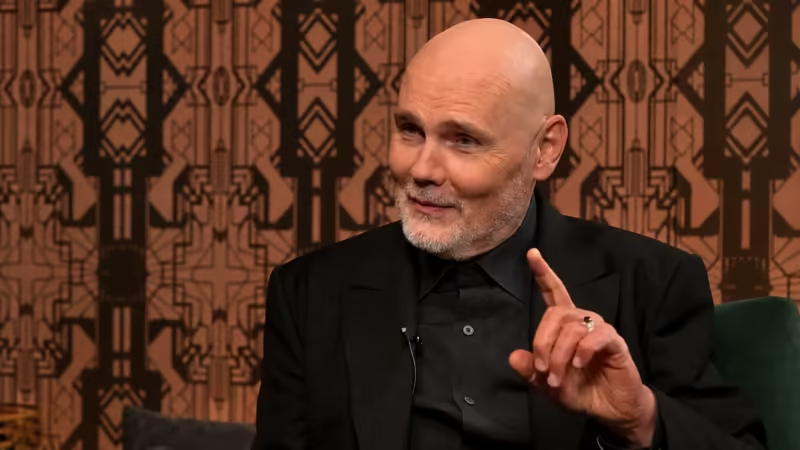
On September 23, 2026, Billy released an episode of his podcast, The Magnificent Others, featuring Michael Sweet of the Christian metal band Stryper. The two men had much in common, for both had been raised in church, both had wandered into the world of rock, and both had found their way back. Early in the conversation, Billy recalled the Christians who objected to a line in “Zero,” one of his songs from the 1990s. He remembered meeting some of them in parking lots and reminding them that he was a Christian too; that he was, in his words, “on your team.” Their condemnation, he told them, was only pushing him away.
Taken alone, such a statement could be heard much like the thanks offered to God from awards show stages; sincere, no doubt, but open to many meanings. The word Christian can mean a great many things to a great many people. Michael Sweet observed that many in the music business are Christians who admire Stryper’s boldness, yet they only ever say so in a whisper. Their reason, he believed, was fear.
But as the conversation drew on, Billy went further. “I’m a Christian as well,” he told Sweet, and he credited both Sweet and Mark Farner of Grand Funk Railroad with showing him that a rock musician could speak openly about his faith. He recalled once telling Rolling Stone that God is the third rail of rock and roll; that to speak of Him is to risk throwing a career away. Then came the words that settled the matter. Billy explained that he had decided to speak honestly about God in his life and about “believing in Jesus as my Lord and Savior.” If it hurt his career, he said, he did not care.
A man may thank God, speak of spirituality, and even call himself a Christian in a general sense, but to name Jesus as Lord and Savior is the confession at the very heart of the Gospel. It is the clincher; the moment a searching heart declares where it has found its rest. Billy explained his reasoning plainly: “If I can’t be willing to be honest with who I am, well, what am I asking a fan to believe in?”
Just as notable was his humility, for he made clear that he had never seen himself in the position of a preacher, and he had no desire to pressure anyone into believing as he does. When pressed by skeptics, he answers that believing in what cannot be seen is the very meaning of faith. Once again, he refused the pulpit. He simply told the truth about who Jesus is to him.
A Gift Meant to Be Used
Later in the conversation, Billy shared why he continues to write and release so much music, and his answer was one that any follower of Christ would recognize. If God gave him a talent, he said, then it was his responsibility to use it. He could never know which song, even one that few people noticed, might carry someone through the darkest hour of their life. That was not for him to decide. His task was only to be faithful with the gift. Such a view echoes the parable of the talents, in which the servants who pleased their master were those who put his gifts to work rather than burying them in the ground.
A Confession Decades in the Making
Billy Corgan’s story is a reminder that faith does not always arrive on a tidy timeline. There was a Catholic boyhood, a season of crisis, a prayer at a grotto, a hymn on a rock album, a long search through many traditions, and at last, a plain confession of Jesus as Lord and Savior. Through it all, Jesus was there the whole time, patiently drawing Billy toward that confession. If you have loved ones whose faith seems scattered or uncertain, never stop praying for them. The Lord who never let go of Billy Corgan is the same Lord who holds them still.
Nearly two centuries ago, Henry Francis Lyte wrote words that now ring true of the rock star who once sang his hymn:
Perish every fond ambition,
All I’ve sought or hoped or known;
Yet how rich is my condition!
God and heaven are still my own.
“That if thou shalt confess with thy mouth the Lord Jesus, and shalt believe in thine heart that God hath raised him from the dead, thou shalt be saved.”
– Romans 10:9 KJV