Caleb Flynn Trial: Quick Facts
- Defendant: Caleb Flynn, 40, former worship leader and 2013 American Idol contestant
- Victim: Ashley Flynn, 37, teacher, coach, and church volunteer
- Date and location: February 16, 2026, at the couple’s home in Tipp City, Ohio
- Charges: Aggravated murder, murder, felonious assault, and tampering with evidence
- Plea: Not guilty
- Court: Miami County Common Pleas Court in Troy, Ohio, with Judge Jeannine Pratt presiding
- Key witness: Alleigha Botner, a former worship intern who testified to an affair with Flynn (she hasn’t been charged)
- Status as of September 26, 2026: The prosecution is still presenting its case. Testimony resumes September 28. No verdict.
A Miami County jury found Caleb Flynn guilty on Tuesday, September 29, of murdering his wife, Ashley, in their Tipp City, Ohio, home. Jurors convicted the 40-year-old former worship leader and one-time American Idol contestant on all nine counts against him, including aggravated murder, CNN reported.
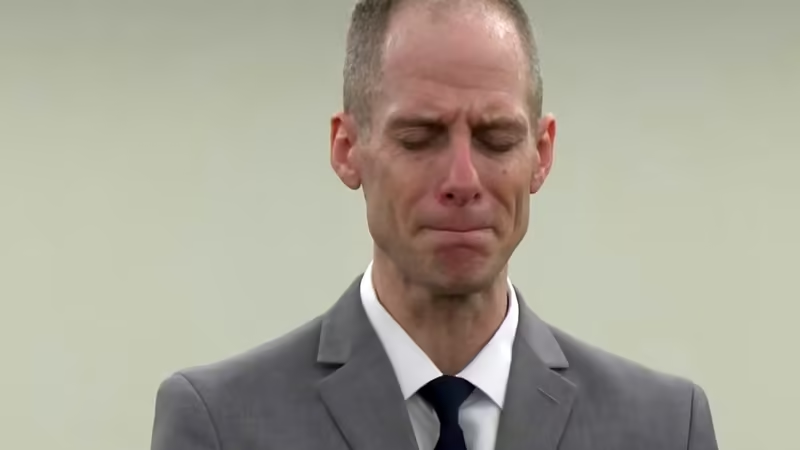
The jury deliberated for less than three hours. Flynn wept as Judge Jeannine Pratt read the verdicts, and members of Ashley’s family were seen crying afterward, according to NewsNation. Pratt revoked his bond and set sentencing for October 5, ABC News reported. He faces up to life in prison without the possibility of parole.
His attorney says an appeal is coming.
For background on Flynn’s ministry career, the affair, and testimony from the trial’s first week and a half, see our earlier coverage.
Caleb Flynn Found Guilty on All Nine Counts
The jury convicted Flynn of one count of aggravated murder, three counts of murder, two counts of felonious assault, and three counts of tampering with evidence. The tampering counts involved the missing firearm, the side garage door, and emails, according to Fox News. Jurors also found that Flynn used a firearm in connection with seven of the charges, which carries a sentencing enhancement, CBS News reported. Two misdemeanor intimidation counts from the original indictment were dismissed and never went to the jury, according to WHIO.
The aggravated murder conviction is the most serious. Under Ohio law, it requires the state to prove “prior calculation and design,” meaning Flynn planned the killing in advance. That element is already shaping the defense’s plans for appeal.
Several of the counts overlap, since they describe a single act. Fox News reported that the first six counts are expected to merge for sentencing.
How Prosecutors Built the Case Against Caleb Flynn
Prosecutors built a largely circumstantial case. Over eight days of testimony, jurors heard from 40 prosecution witnesses, NBC News reported. The murder weapon was never found. Assistant Prosecutor Matthew Joseph reminded jurors that recovering the gun isn’t an element the state has to prove, then walked them through what they did know: Flynn kept a 9mm handgun in his truck console, the truck was parked in the garage, the console was open before police arrived, and Ashley was shot twice in the head with 9mm bullets.
The alleged break-in came apart under examination. FBI Special Agent Sarah Deamron testified that she found no pry, kick, or ram marks on the outside of the door. The gouge marks were on the inside trim of the frame, and she said the door wasn’t consistent with a forced entry, according to CBS News.
Prosecutors also pointed to what happened before and after the shooting. In his rebuttal, Miami County Prosecuting Attorney Paul Watkins told jurors that Flynn removed security cameras 20 days before the killing, including one that would have captured anyone entering from the garage. On the day of the shooting, Watkins said, Flynn was deleting apps from his phone and trying to delete messages. Joseph argued that at the time Flynn claimed to be asleep, his devices showed him awake and moving.
The state’s theory of motive had three parts. By appearing to be the victim of a tragedy, Joseph argued, Flynn could keep his well-paying job in Ashley’s family business, collect on her life insurance, and hold on to his role as a worship leader with “zero impact to his reputation within the church.”
Watkins closed by telling jurors that Flynn had a lawful way to leave his marriage and chose otherwise. His final line to the jury: “People lie. Evidence doesn’t.”
The Defense Rested Without Calling Witnesses
Flynn didn’t testify, and his attorneys called no witnesses. Defense attorney Patrick Mulligan pointed to the three recorded police interviews jurors had already watched, in which Flynn denied killing his wife.
In closing, Mulligan argued that the state’s evidence was circumstantial and that the only thing prosecutors had proved was the affair. He reminded jurors that Flynn voluntarily spoke with detectives three times, consented to searches of his home and phone, and gave his fingerprints. He framed the jury’s task as a question of “proven versus not proven,” according to CNN.
The defense also questioned the lost devices of Alleigha Botner, the former worship intern who testified to an affair with Flynn. Botner said her phone fell into the water on a trip to Clearwater, Florida, and her work laptop was lost on a flight home, weeks before Ashley’s death. The defense suggested that wasn’t a coincidence. Ring video shown at trial placed Botner at home at the time of the killing, CBS News reported. She hasn’t been charged.
Other gaps the defense raised didn’t sway the jury. Investigators never tested Flynn for gunshot residue. Detective Sgt. Mike Morgan of the Tipp City Police Department explained that Flynn’s own account (reaching the bedroom within seconds of the shots) meant residue would have been expected regardless, WHIO reported. Investigators also testified that none of Ashley’s blood was found on Flynn or his clothes.
What Happens Next: Caleb Flynn Sentencing and Appeal
Sentencing is set for Monday, October 5, at 3 p.m. in Miami County Common Pleas Court. An aggravated murder conviction in Ohio carries a potential sentence of life without parole.
Mulligan told reporters that Flynn maintains his innocence and that he expects to file a notice of appeal. Asked about possible grounds, he pointed to what he called insufficient evidence of prior calculation and design, according to ABC News. An appeal on that element would challenge the aggravated murder conviction specifically. It wouldn’t automatically affect the other counts.
What the Caleb Flynn Verdict Means for Church Leaders
Our first article raised practical questions about oversight of volunteer and contract worship leaders. The verdict, and the way prosecutors argued their case, adds another layer.
Prosecutors named Flynn’s standing in the church as part of his motive. That fits the messages read at trial. In a September 2025 text, Flynn listed his church involvement alongside his job, his income, and his housing as things he’d lose by leaving his marriage, PEOPLE reported. In evangelical churches, a worship leader who left his wife for a younger member of his team would lose his place on the platform. Most church leaders would call that appropriate accountability. The state’s case suggests Flynn saw that platform as something worth protecting at almost any cost.
The case also shows how completely a leader’s public life can mask his private one. Ashley’s family supported Flynn in the days after the shooting, and he and his daughters stayed with her parents before his arrest, according to the Dayton Daily News. On cross-examination, the defense emphasized that the family had initially believed he was innocent, WKEF reported. The people who knew him best didn’t see it.
Christian Life Center’s response offers a workable model for churches facing something similar. Pastor Jordan Hansen publicly honored Ashley, grieved with her family, and said the church would keep cooperating with law enforcement, according to NewsNation. Care for the grieving and full cooperation with investigators can happen at the same time.
For pastors, the harder takeaway is how ordinary the warning signs looked from the outside. A worship leader who seemed devoted to his family. A volunteer role with little formal oversight. A relationship that began on the team and moved into private messages. None of it was visible from the pews.
In February, Hansen wrote that two young daughters had lost their mother. They’ve been in the care of Ashley’s sister and brother-in-law, Kayla and Matthew Keyt.