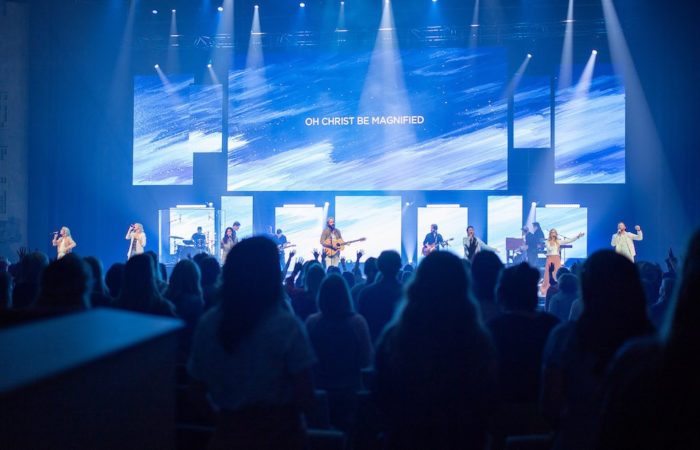
Have you ever walked out of a worship service feeling more talked-at than having worshipped? Like somewhere between the third song and the offering, the words just kind of piled up?
Yeah. Me too.
Here is the thing about worship leading that nobody really warns you about when they hand you a microphone. Words are currency. And just like actual money, you can spend them wisely or you can blow through them like a college freshman with their first credit card. The goal is not to say more. The goal is to say what matters and then get out of the way.
Theologians call it the economy of words. I call it one of the hardest disciplines a worship leader will ever practice.
Why Every Spoken Word in Worship Is a Precious Resource
Think about how an economy works. You have limited resources. You manage them carefully. You spend where there is return. You cut what is waste. A healthy economy is not the one with the most money flying around. It is the one where what is available is being used well.
Your spoken moments in a worship service work exactly the same way. There is a threshold. A saturation point. Congregation members are spiritual beings, yes, but they are also human beings with finite attention and genuine cognitive limits. After a certain point, more words do not produce more worship. They produce more mental wandering. More checking of phones. More nodding that has nothing to do with agreement.
Quality over quantity. Not how much you say, but what your words actually accomplish.
Scripture is full of this principle, by the way. Proverbs 25:11 says a word fitly spoken is like apples of gold in settings of silver. Not a lot of words—a word, but fitly spoken. That is the standard we are aiming for.
The Theology Behind Saying Less
Here is where it gets really interesting. And maybe a little humbling.
Thomas Aquinas, that brilliant medieval theologian, pointed out that because we cannot fully know God, our words about Him are always going to fall short. Always. Our language is analogical at best—pattern recognition, pointing toward something we cannot completely describe. Which means that every word we speak from a platform is, in some sense, an approximation.
That should make us careful. Not silent, but very careful.
There is also the concept of apophatic theology—the idea that sometimes God is more clearly encountered through what is not said than through endless definition. Mystery is not the enemy of worship. Mystery is often the doorway into it. When we over-explain, we can accidentally flatten the very thing we are trying to lift up.
And then there is silence itself. Wendell Berry wrote that silence is a necessary condition for song. Silence is not an absence. It is communication. It creates space for the congregation to stop receiving and start listening. To participate rather than observe. Practicing silence in worship is actually an invitation for the church to share in the life of God together. That is not nothing. That is everything.
The primary word in any worship service should be the Incarnate Word Himself. Our commentary is a signpost, not the destination. A signpost that points to itself is a very bad signpost.
Modern Attention Spans Are Not Your Enemy
Before you get defensive, hear me out. This is not about dumbing things down. It is about being realistic.
Pope Francis famously championed what some call the seven-minute rule for homilies—the idea that a focused, distilled seven minutes will do more than a sprawling twenty-five. The discipline of brevity is not laziness. It forces you to identify what is actually essential. What cannot be cut. What is the one thing you need the congregation to walk away carrying.
We also live in a post-literate world—a world shaped more by image and ritual and experience than by long-form verbal narrative. That does not mean preaching is dead or that words do not matter. It means that arts, music, movement, and visual elements can often carry what our voices alone cannot. You do not have to make the microphone do all the work. And honestly, trying to make it do all the work is probably what got us into trouble in the first place.
There is also a purely practical acoustic consideration worth mentioning. In many sanctuaries, especially older ones with hard surfaces and live reverb, extra words do not clarify. They muddy. Literally. Sound engineers talk about the Speech Transmission Index—a measure of how intelligible speech is in a given room. Fewer, clearer words improve that index. More words often just add reverberant mud. So sometimes using less is not just spiritually wise. It is acoustically merciful.
How to Choose Which Worship Words to Actually Keep
So what stays? Every word that earns its place. Here is a practical framework.
Ask yourself what your words are doing. Are they instructional—giving the congregation the why and the how of what you are about to do together? Are they exhortational—calling people to a specific response or posture? Are they pastoral—forming the community’s identity, helping them remember who they are and Whose they are? If a word is not doing at least one of those things, it is a candidate for the cutting room floor.
A practical checklist worth running through: use words at the call to worship to help people remember the divine invitation—they were welcomed here before they walked through the door. Use every tool available alongside speech. Let music carry what music can carry. Let Scripture speak for itself. And then—here is the convicting one—if your words are drawing more attention to you than to God, edit them. Or omit them entirely. That one stings a little if you sit with it long enough.
It is worth distinguishing that repetition and redundancy are not the same thing. Artful repetition—a refrain, a recurring phrase, a call and response—is meditative. It deepens. It sinks truth into places that a single pass cannot reach. Redundancy, on the other hand, is saying the same idea multiple times without variation or development. That leads to mental wandering. And mental wandering leads to people counting ceiling tiles. You know it is true.
The Pitfalls That Trip Up Even Experienced Worship Leaders
Let’s be honest about the traps, because they are real and most of us have fallen into them.
The most common one is competing with the preacher. When worship leaders feel pressure to deliver profound spiritual insight between every song, they create word quotas. And those quotas end up doubling down on what the sermon is about to do—which exhausts the congregation before the message even begins. Your job in that space is to prepare the soil, not to plant the crop. Leave room for the sermon to do its work.
There is also what some call holy minimalism—and it is worth getting clear on what it is and what it is not. Holy minimalism is simplifying musical and liturgical structures so the mystery of the Gospel has room to breathe. It is intentional restraint in service of transcendence. What it is not is doctrinal minimalism—watering things down, avoiding substance, glossing over the hard and beautiful truths of the faith. Simplicity in form. Richness in content. Those two can and should coexist.
And then there is the extempore overload. The unscripted pastoral flow moment that starts with good intentions and somewhere around minute four has drifted into territory even the speaker cannot fully explain. Matthew 12:36 is sobering here—Jesus told us we would give account for every idle word. Not every word. Every idle word. The antidote is preparation. Not robotic scripting, but thoughtful, prayerful preparation that honors the moments you have been given.
Creating Space for the Spirit Instead of Saturation
Here is the goal, and it is a beautiful one. The aim of word economy is not brevity for the sake of saving time. It is intentionality for the sake of encounter.
When words and music and silence are working together in rhythm—each one doing its specific job without stepping on the others—something happens in a room. The congregation stops managing input and starts experiencing presence. The story of God gets told without overwhelming the people who most need to hear it. And instead of a saturation of noise, you get a saturation of the Spirit.
That is what we showed up for. That is what every worship leader is really after, even if they have never defined it.
So go back through your service flow this week. Look at every spoken word. Ask the hard questions. Is this earning its place? Is it pointing toward God or toward me? Could silence do this better? Could music carry this? And then cut bravely, trust deeply, and leave room.
Because a worship service where God has space to move—uncluttered, unhurried, unobstructed—that is a very good gift.
Proverbs 25:11
A word fitly spoken is like apples of gold in settings of silver.
Matthew 12:36
I tell you, on the day of judgment people will give account for every careless word they speak.