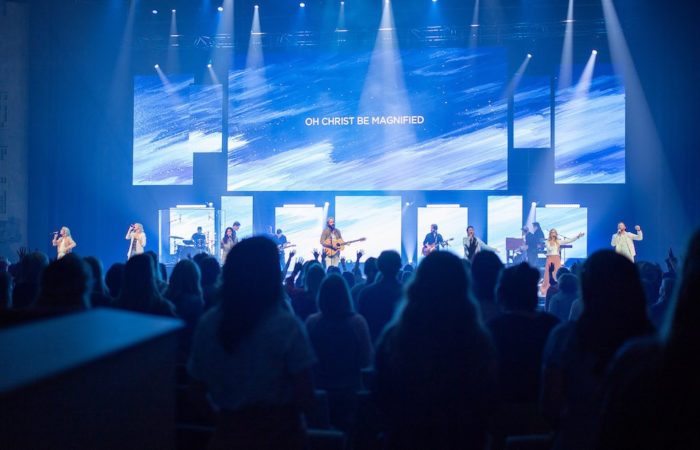
Do you ever feel like somewhere between loading in your gear and hitting the downbeat, you’ve forgotten why you’re even up on stage?
You spent the week hunting down chord charts, transposing tracks, dialing in patches. And then Sunday comes and you’re just trying to survive the set without a train wreck. Sound familiar?
The Invisible Pressure Every Worship Keyboardist Carries
The tension is real, as keyboardists are constantly expected to be everywhere and nowhere at once. You must skillfully fill the gaps, color the chords, and hold the pad smoothly through every transition. Yet, you face the endless challenge of staying out of the way of the guitar, never muddying up the bass, and striking the perfect balance to avoid overplaying without completely disappearing from the mix.
That’s a lot of invisible math to do while also, you know, trying to actually worship.
And if you’re not careful, the whole thing turns into a technical exercise. Right notes, right patches, right timing. Meanwhile your heart is somewhere back in the green room with your coffee.
Why Preparation Actually Matters More Than Talent
Thing is, excellence in worship isn’t about being the most gifted player in the room. It’s about stewardship. God gave you ears, hands and a heart, and He expects you to bring all three, not just the ones that show up easiest.
When you show up Sunday morning without having really listened to the recording, without knowing whether that bridge is guitar-driven or keys-driven, without a plan for your left hand, you’re not just underprepared musically. You’re distracted spiritually. You’re so busy scrambling to keep up that there’s no room left to actually lead anyone into the presence of God.
Preparation isn’t the opposite of Spirit-led worship. It’s what makes Spirit-led worship possible, because it frees your mind to actually be present instead of panicking.
What Most Worship Teams Try (And Why It Doesn’t Work)
Most of us default to one of two extremes.
Either we overprepare on the technical side, memorizing every voicing and building the perfect patch bank, and then walk on stage stiff as a board, eyes glued to the iPad, completely disconnected from the room. Or we underprepare entirely, telling ourselves the Holy Spirit will just show up and cover for us, and then spend the whole set guessing our way through key changes and stepping all over the acoustic guitar’s frequencies.
Neither one glorifies the Lord. The first turns worship into a recital. The second turns it into chaos wearing a worship shirt.
There’s a third way, and it starts long before Sunday.
Building A Keyboard Rig That Actually Serves The Song
Start with the listening. Not a passive, half-hearted listen while you scroll your phone, but real, active listening to the original recording. What is the keyboard actually doing? Is it a rhythmic engine or an ambient wash? Is there a signature riff you need to nail, or moments where the best thing you can play is nothing at all?
Then build your sound palette on purpose. Acoustic piano and warm e-piano for foundation. Pads and strings for atmosphere. B-3 organ when the song calls for grit and soul. Whether you’re running hardware banks on a Nord or Korg, or building patches in MainStage or Ableton, the goal is the same. Every sound should serve the song, not your ego.
And map it all out. Chart your transitions. Mark where you sit out. Note the D.S. al Coda, the tag ending, the dynamic drop before the bridge. A roadmap isn’t a crutch. It’s what lets you eventually set the chart down and just play.
Playing Chords That Leave Room For The Bass Player To Breathe
Let’s talk voicings for a second, because this is where a lot of good keyboardists accidentally step on their bandmates.
Open fifths. Add2 and Add9 chords. Sus4. Major 7ths for warmth. These give you that modern, spacious worship sound without turning your left hand into a bulldozer. Anchor your thumb and pinky on the 1 and 5, and suddenly you’ve got open, contemporary textures without fighting the bass player for the low end.
Speaking of which, leave the basement to the bass. Anything below G2 or C3 belongs to them, not you. If the guitars are already filling the midrange, move up. Use your high register or a sustained pad to add color without clutter. Less really is more. A steady quarter note pulse with a metronome in your ear will serve the room better than a flurry of arpeggios ever will.
Moving From Charts To Memory To Actual Worship
Here’s where it gets good. As you internalize the songs, listening through the week, practicing with a click, weaning yourself off the chart until the iPad is just a backup, something shifts. You stop performing the music and start experiencing it.
That’s when you can finally look up. Make eye contact with the congregation. Watch your worship leader instead of your fingers. Let your face and your posture say what your hands have already learned to say fluently.
Because at the end of the day, this was never about the gear or the voicings or the patch banks, even though all of that matters. It’s about a heart that’s been prepared all week showing up fully present on Sunday, hands ready, spirit ready, pointing a room full of people toward the God who is actually worthy of every note.
Try This Sunday
Pick one song from this week’s set. Really listen to it, start to finish, before you ever touch a key. Notice what the keyboard is doing and why. Build your patches around that role instead of around habit. And when you play it live, leave one moment of silence where you’d normally fill space, just to remind yourself that the song, and the room, don’t actually need you to do everything.
That small act of restraint might be the most worshipful thing you play all week. And that, friend, is a good gift.