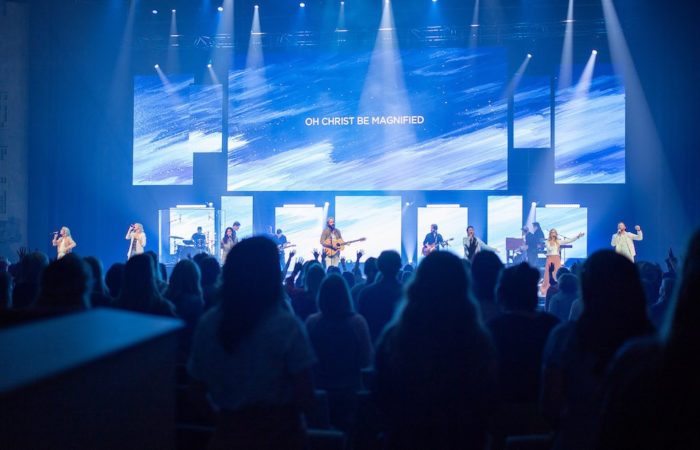
Your setlist is a theological statement. Every single week.
Maybe you have never thought about it quite that way. Maybe you think of it as a playlist—a practical stack of songs you need to get through before the pastor stands up. But what you may be missing is the songs your congregation sings Sunday after Sunday are quietly forming what they believe about God, about themselves, about suffering, about joy. They are being fed. And you are the one holding the spoon.
That is a weighty thought. But it is also a genuinely good gift! Because it means what you do on that platform matters far more than you might realize on a tired Tuesday when you are staring at Planning Center and wondering if anybody will even show up.
So let’s talk about how to do this well.
Songs Are the Theological Diet of Your Church
Think about it this way. Paul tells us in Colossians 3:16 to “let the word of Christ dwell in you richly as you teach and admonish one another with all wisdom through psalms, hymns, and songs from the Spirit.” That is not a throwaway line. Corporate singing was always meant to be two things at once: vertical and horizontal. Vertically, we are singing to God (adoration, thanksgiving, surrender) and, horizontally, we are singing to each other (encouragement, reminder, declaration of shared faith).
A congregation in grief needs songs that give them language for lament. A congregation that has just come through something hard needs songs that declare the faithfulness of God. Not as a greeting card sentiment, but as a battle cry born from experience. A congregation full of skeptics and seekers needs songs that are honest and accessible, not insider language dressed up in a minor key and called “deep.”
Your setlist is pastoral work. The question is not just “does this song sound good?” The question is “does this song feed my people what they need right now?”
The Power of the Songs Your People Actually Know
Here is something that might sting a little. Your congregation is probably not singing as freely as you think they are. Not because they don’t want to. But because they don’t know the songs well enough yet.
Research suggests it can take up to seventeen times of singing a song before a congregation really catches on. Seventeen! That is a lot of Sundays. So before you retire that song because you are tired of it, ask yourself whether your people have actually inhabited it yet.
This is the case for what some leaders call “blue-chip” songs (well-loved anthems the church can belt out at full volume with their eyes closed). These are not lazy choices. They are anchors. They give people a safe place to stand while you introduce something new. A wise set has both the familiar and the fresh, held in good tension.
And while we are here, key selection is an act of hospitality. Choose keys that allow the average person in your congregation to actually sing. Not the gifted soprano in the third row. The tired dad of four in the back who came in carrying a lot and just needs to get his voice out. If a song only works for trained vocalists, it is a performance piece, not a congregational song. There is a place for performance. Sunday morning is not usually it.
Building a Set That Actually Goes Somewhere
A good setlist is not just a stack of songs. It is a journey.
Some leaders use the Tabernacle model as a guide which is moving from the outer courts of praise and thanksgiving into the inner courts of intimacy and reverence. It is not a rigid formula. It is a shape. There is wisdom in starting where scattered, distracted, burdened people actually are, and moving them toward the throne of God with some intentionality.
Musically, this means thinking about keys and tempo with a plan behind them. Grouping songs in the same or complementary keys (think fourths and fifths) keeps things from feeling jarring and keeps momentum going. The traditional arc moves from high energy down into intimacy. But a “mid-tempo groover” to open can be a warm welcome that eases people in before the energy rises. Neither approach is wrong. But neither should be accidental.
Lyrical bridges are one of the best tricks in the toolkit. When the last phrase of one song connects to the opening of the next, you create what feels like a single, unbroken moment of worship. “How Great Is Our God” flowing right into “How Great Thou Art” is the classic example. It is not a gimmick. It is good shepherding.
Plan to Be Spontaneous (Yes, Really)
The most Spirit-led moments in worship almost always happen when the leader is over-prepared. Not in spite of preparation. Because of it.
When your team knows the songs cold, when the transitions are locked in and the keys are sorted, you are free to lift your head out of the music and actually read the room. You can linger. You can respond to what the Spirit is doing. You can call an audible. But only if you are not white-knuckling the chart stand trying to remember the bridge.
One of the best practical habits a worship leader can develop is the “one less song” rule. Build your set, then pull one. That empty space is not a problem. It is an invitation—for a moment of prayer, for a scripture reading, for quiet reflection, for whatever the moment needs. You don’t have to fill every second. Sometimes the most powerful thing you can do is stop and let people breathe.
And if your congregation comes in cold, a short story, a simple piece of scripture, or even just an honest moment of acknowledgment from the platform can “thaw” a room. You are not manipulating people into worship. You are just meeting them where they are and walking in together.
Know Who You Are Leading
This one is personal. Who is actually sitting in those seats?
Multi-generational congregations are one of the great gifts of the local church, and one of the great challenges of worship planning. The 70-year-old who has sung hymns since childhood and the 17-year-old who found God through a Spotify playlist are both standing in your room on Sunday morning. Both of them matter. Both of them deserve to be reached.
Modern hymns are one of the most effective bridges we have right now. They give older generations the theological depth and familiar language they treasure, wrapped in arrangements that younger worshippers can connect with. They are not a compromise. They are a gift to the whole church.
But here is a conviction worth sitting with. The next generation needs to feel like Sunday morning has a seat for them. If your worship culture never reaches them, the culture eventually disappears. Prioritizing songs that engage younger worshippers is not capitulation. It is faithfulness to the future God is building.
The Stuff That Makes It All Work
None of the above matters if you are building sets reactively at 11pm on Saturday. Plan ahead. Six to eight weeks out is not excessive, it is wise. It lets you check whether your theological diet is actually varied, whether you have been camping in one emotional register for too long, whether you have any songs of lament in the rotation, or confession, or sending.
Categorizing your songs by function helps enormously. Some suggestions are Call to Worship, Creed, Praise, Adoration, Confession, Response, Sending. These are not rigid slots. They are a way of making sure you are not accidentally feeding your congregation the same thing seven different ways every week.
Talk to your pastor. Regularly. Align your sets with the sermon series and the season the church is in. You are not a separate department. You are co-pastoring. The more connected those two things are, the more unified the whole service becomes.
And finally, have a plan for when things go sideways. Because they will. A technical failure, a missed cue, a drummer who drops the beat in the middle of a tender moment. These are not catastrophes unless you treat them like catastrophes. A leader who stays calm and keeps moving communicates something profound to the congregation – we are not here for a flawless production. We are here to meet with God. And He shows up even in the train wrecks.
The Leader Who Plans Is the Leader Who Is Free
Psalm 33:3 says “Sing to him a new song; play skillfully, and shout for joy.” Skillfully. There is intention in that word. There is preparation. There is craft. And it sits right next to joy, which means the two are not in opposition. Excellence in preparation does not squeeze the life out of worship. It makes room for it.
You are not just a musician. You are a pastor with an instrument. The setlist you build this week is an act of love for the people God has entrusted to your leadership. It is theology handed to people who may never open a systematic theology book. It is a voice for the grieving and the grateful and the doubting and the certain, all standing in the same room at the same time.
Build it like it matters. Because it does.
And that, dear worship leader, is a very good gift.
Colossians 3:16
Let the word of Christ dwell in you richly as you teach and admonish one another with all wisdom through psalms, hymns, and songs from the Spirit, singing to God with gratitude in your hearts.