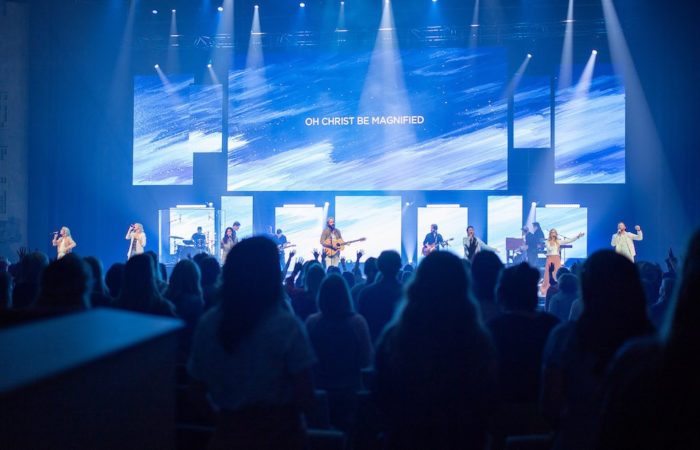
Who decides how loud is loud enough on Sunday morning? If your answer is “whoever complains first,” keep reading.
Every church has the thermostat wars. One person is freezing, another is sweating, and the poor soul near the vent has given up entirely. Volume works the same way. The retired couple in the fourth row want it softer. The college students in the back want to feel the kick drum in their sternum. The sound tech is stuck in the middle, hands hovering over faders, wondering which glare to risk.
Why There Is No Magic Volume Number for Church Sound
The honest truth is that there is no single perfect volume for every church. A stone sanctuary with a gorgeous echo behaves nothing like a carpeted room with acoustic panels. A congregation full of toddlers and grandparents has different needs than a church plant in a converted warehouse.
But that does not mean anything goes. A church service should sound professional, clear and immersive, and it should not sound like a rock concert. The goal is full engagement during the sermon, the prayers and the singing, without anyone leaving with ringing ears or a headache.
Why Volume Affects Hearing Health and Congregational Singing
This matters more than we’d like to admit. Too loud, and people stop singing because they cannot hear themselves. Some will even step into the lobby to give their ears a rest. And over time, repeated exposure can genuinely damage the hearing of the people we are trying to serve.
Too soft, and the room feels flat. The team sounds timid, and the congregation hesitates to sing out because nobody feels held up by the music.
So volume is really a pastoral decision wearing a technical costume. Three things should shape it. The first is hearing safety for everyone in the room. The second is the vision of your pastor and leadership team. The third is how the congregation actually responds, meaning they can hear their own voices while still feeling supported by the band.
What Most Churches Try When the Sound Feels Wrong
When the sound needs fixing, we usually just guess. The tech turns things up, someone complains, so the tech turns things down, someone else complains, and the cycle repeats until everyone is plain worn out.
Some churches copy the sound of a favorite concert recording. Others pull out a phone, download a free decibel app and call it a day. A few set the faders once on Saturday and walk away, trusting that Sunday will take care of itself.
Why Guessing and Phone Apps Fail Your Congregation
Because we are measuring the wrong thing, or measuring the right thing badly.
Human ears respond to sound pressure level, usually called SPL, which is the force that sound waves exert on the air around us. That is not the same as how loud something feels on a fader. And a phone alone is a shaky tool. Without a calibrated external microphone, most phone mics clip somewhere around 100 dB SPL, which means the reading falls apart right when you need it most. A dedicated hardware meter like the Galaxy Audio CM140 is better for front of house readings. If you prefer your phone, pair it with a calibrated mic such as the Dayton Audio iMM-6.
Even with good gear, settings matter. A-weighting, written as dBA, mimics how the human ear actually hears, trimming the lowest and highest frequencies. It is the right choice for speech and most worship mixes. C-weighting, or dBC, keeps the low end intact, which makes it useful for pipe organs or bass-heavy mixes. And response speed matters too. Fast captures every snare hit. Slow, which averages over a full second, tells you where the room truly lives.
Without those details, two people can read the same number and see completely different things.
How to Set Church Sound Levels This Sunday
The good news is that you can start this week with a little patience and a notebook.
First, pick your meter and your settings. Use A-weighting and the slow response, then write your readings the same way every time, such as 88 dBA\:slow. Record the max reading on the slow setting rather than chasing the random peak spikes.
Second, map your room. Sketch your seating area and lay a twelve-foot grid over it. Play pink noise through the system, which carries equal energy per octave and matches how we naturally hear. Walk the grid with your meter and write down what you find at each intersection. You are hunting for hot spots and dead zones. Aim to keep the variation within about five dB either way. If the front row is deafening and the back row is straining, the knob is not your problem. The coverage is.
Third, learn your room’s numbers. Check the noise floor with the heating or air running and the congregation seated. Find the point where your system starts to distort. The gap between your normal mixing level and that distortion point is your headroom. The span from the noise floor to the maximum clean volume is your dynamic range. Those four numbers tell you what your room can actually do.
Fourth, set a range for each part of the service. Spoken word and preaching generally land between 68 and 75 dBA, loud enough to be clear without feeling harsh. Musical worship typically sits between 82 and 92 dBA slow, depending on your room, your style and your church culture. Pray over those numbers with your pastor and leadership team. They are starting points, not commandments.
Fifth, mix actively. A sermon is not a song, and a prayer is not a bridge. The best sound teams ride the faders through spoken transitions, quiet moments and big musical climaxes. A static mix in a living service always feels a little off.
And finally, write it all down. Record your target ranges, your meter settings and your booth calibration where every tech on the team can find them. When the volunteer who runs sound on the second Sunday of the month mixes the same way as the one who runs it on the first, your congregation gets to relax into the music instead of bracing for it.
Leading Worship Through Sound with Care
Sound ministry is a quiet, often thankless way of loving people. When you protect ears, set clear numbers and serve your church week after week, you give them room to hear God and each other. Because hearing God’s Word comfortably and clearly is a good gift.